
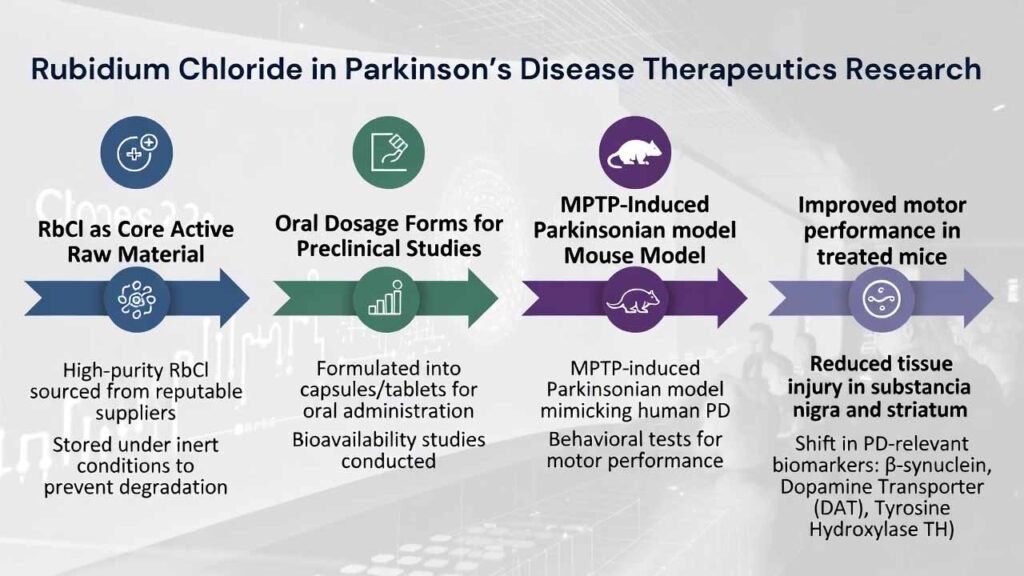
Rubidium Chloride in Parkinson’s Disease Therapeutics Research: Formulation & Preclinical Evaluation Workflow
1) Overview
Parkinson’s disease (PD) is a progressive neurodegenerative disorder characterized by motor symptoms (resting tremor, bradykinesia, rigidity, postural and gait impairment) and frequent non-motor symptoms (e.g., constipation, sleep disturbance, mood changes). Because disease mechanisms are complex and not fully resolved, preclinical programs often combine behavior, histology, and molecular biomarkers to identify candidates with potential neuroprotective effects.
In this workflow, rubidium chloride (RbCl) is treated as the core active raw material and formulated with pharmaceutically acceptable excipients into permitted dosage forms suitable for oral administration. Efficacy is evaluated in an established MPTP-induced Parkinsonian mouse model, where RbCl administration is associated with improved motor performance, reduced tissue injury in substantia nigra/striatum, and favorable shifts in PD-relevant biomarkers (including α-synuclein, Dopamine Transporter (DAT), and Tyrosine Hydroxylase (TH)).
2) Detailed Experimental Process
2.1 Materials, Controls, and Key Inputs
- Active raw material: Rubidium chloride (RbCl), defined purity grade (e.g., ≥98% for screening; higher grades for translation).
- Modeling agent: MPTP (used to induce Parkinsonian phenotypes in mice under strict safety and ethics controls).
- Positive control: A standard symptomatic comparator (e.g., a levodopa-containing product) for benchmarking behavioral improvement.
- Pharmaceutically acceptable carriers (examples): diluents, solubilizers/co-solvents, disintegrants, dispersants, lubricants, flavoring agents, antioxidants, binders, absorbents, wetting agents, buffers, crosslinkers.
Development focus: treat RbCl as the primary efficacy-driving component and design excipient choices around its solubility, stability, dosing accuracy, and compatibility with the intended dosage form.
2.2 Animals and Study Readiness
- Typical strain/age window: adult C57BL/6J mice (commonly used in MPTP paradigms).
- Acclimatization: allow adaptation to housing conditions before experiments.
- Baseline screening: perform repeated open-field sessions to exclude animals with abnormal spontaneous activity before randomization.
- Randomization: assign animals to control/model/treatment arms after baseline characterization and model confirmation.
2.3 Parkinsonian Model Induction and Grouping Strategy
- Model induction: establish a Parkinsonian phenotype using a recognized MPTP regimen per institutional SOPs (route, dose, and schedule defined by approved protocol).
- Model confirmation: use early behavioral scoring checkpoints to confirm motor impairment and eligibility for treatment assignment.
- Experimental arms (example framework):
- Normal control (vehicle)
- Model control (MPTP + vehicle)
- RbCl low / medium / high dose groups (dose-ranging to establish exposure–response)
- Positive control group (standard symptomatic comparator)
Engineering value: dose-ranging groups are critical for defining a minimum effective exposure and identifying an upper window where benefit plateaus or tolerability becomes limiting.
2.4 Formulation Development (RbCl as the Key Active)
| Formulation Task | Recommended Practice for R&D |
|---|---|
| Dosage form selection | Prioritize oral forms suitable for gavage in preclinical testing (solution or suspension), then map to scalable human-acceptable forms (tablets/capsules/granules) if warranted. |
| Carrier system choice | Select buffers/wetting agents/dispersants to maintain uniformity and dose accuracy; match excipients to the required release and stability profile. |
| RbCl quality attributes (CQAs) | Define assay (RbCl content), moisture, insolubles, and ionic impurities (especially Na/K limits); control heavy metals for neuro-focused programs; confirm lot-to-lot consistency via CoA. |
| Preparation workflow | Weigh RbCl accurately; dissolve for solutions or disperse for suspensions; adjust pH/buffer if needed; verify clarity/particle uniformity; label concentration to enable mg/kg conversion. |
| Stability & handling | Run short-term stability (appearance, concentration, precipitation) across storage conditions used in the study; confirm compatibility with container closure. |
Practical note: because RbCl is an inorganic salt with high aqueous compatibility, formulation effort can often focus on dose precision, impurity control, and reproducible preparation rather than complex solubilization.
2.5 Administration Plan and Observation Windows
- Route: oral administration (gavage-compatible dosage form).
- Dose principle: treatment-effective RbCl amount defined per body weight; a minimum daily dose threshold may be applied in the study design (e.g., not less than 0.5 mg/kg/day as a starting reference), followed by low/medium/high escalation.
- Monitoring: record body weight routinely; observe for tremor/paralysis-related signs after dosing within a fixed post-dose window.
- Behavioral testing cadence: evaluate at defined checkpoints (e.g., mid-course and end-of-course) to capture trajectory rather than single time-point effects.
2.6 Behavioral Readouts (Motor & Coordination)
Use a multi-test battery to reduce false positives and capture complementary motor domains:
- Tremor/paralysis score: graded observation of symptom severity within a defined observation window after dosing.
- Open-field activity: track locomotion by grid crossings in a square arena for a fixed duration; translate crossings to an activity score.
- Pole test: record time required to descend from an elevated position along a wrapped pole; convert time to score bands.
- Hanging (grip) test: assess hindlimb grasping ability on a horizontal line/wire; score by ability to secure grip.
- Swim test: quantify coordination/strength by measuring float time in a temperature-controlled water tank within a set interval.
Data practice: report each test plus a composite (sum) score to show consistent improvement across endpoints.
2.7 Tissue and Biomarker Verification
- Histopathology (HE staining): collect brain tissue at the terminal time point; assess substantia nigra and striatum structural injury and treatment-associated improvement.
- Immunohistochemistry: quantify α-synuclein expression in relevant regions to link functional change with PD-associated protein accumulation.
- qRT-PCR: measure mRNA levels of DAT and TH as dopaminergic neuron functional markers; compare treatment arms vs model control.
Translational value: pairing behavior with α-synuclein/DAT/TH provides mechanistic plausibility beyond symptom-only scoring.
3) Comparison vs Traditional Approaches
| Traditional PD Preclinical Approach | This RbCl-Centered Workflow |
|---|---|
| Often emphasizes symptomatic improvement using dopaminergic replacement comparators | Benchmarks against a symptomatic comparator but prioritizes neuroprotection-linked endpoints (α-synuclein, DAT, TH, tissue integrity) |
| Single behavioral test or limited scoring may drive conclusions | Uses a multi-assay behavioral battery plus composite scoring for robustness |
| Active ingredient selection may not tightly integrate raw-material quality strategy | Positions RbCl as the critical raw material with defined CQAs (assay, insolubles, Na/K, metals) supporting reproducible outcomes |
| Mechanistic linkage sometimes indirect | Links function to mechanism through α-synuclein reduction and DAT/TH restoration trends alongside histology |
Summary: the differentiator is not only the active (RbCl) but the integrated evaluation stack—behavior + tissue + biomarkers—built to support credible R&D decision-making.
4) Why Rubidium Chloride Is Advantageous in This Application
4.1 R&D Advantages of Using RbCl as the Active Raw Material
- Formulation-friendly ionic salt: supports straightforward preparation of oral solutions/suspensions for dose-ranging studies.
- High dosing precision: simple composition enables accurate concentration labeling and weight-based administration.
- Scale-up clarity: well-defined chemical identity simplifies tech transfer from screening batches to larger GMP-aligned campaigns.
- Mechanism-relevant readouts observed in the model: improvements align with PD-linked biomarkers (α-synuclein, DAT, TH), strengthening the hypothesis beyond locomotor changes alone.
4.2 What Engineers Should Specify When Sourcing RbCl
- Assay & identity: confirmed RbCl content with traceable analytical methods.
- Moisture & flowability: defined moisture limits to ensure consistent weighing and dissolution.
- Insolubles: low insoluble fraction to prevent suspension variability and dosing error.
- Ionic impurities: tight control of Na/K and other alkali metals where neurological studies require low background interference.
- Heavy metals: controlled limits for neuro-focused research programs.
- Documentation: CoA, SDS, and lot traceability suitable for regulated R&D environments.
Bottom line for development teams: treating rubidium chloride as the core raw material—then building formulation choices, dosing strategy, and multi-layer validation around it—creates a cleaner engineering pathway from screening to reproducible preclinical evidence in Parkinsonian models.
This content describes a preclinical research workflow and does not claim clinical efficacy in humans. The experimental method of this material references patent application number CN202310819479.0.