
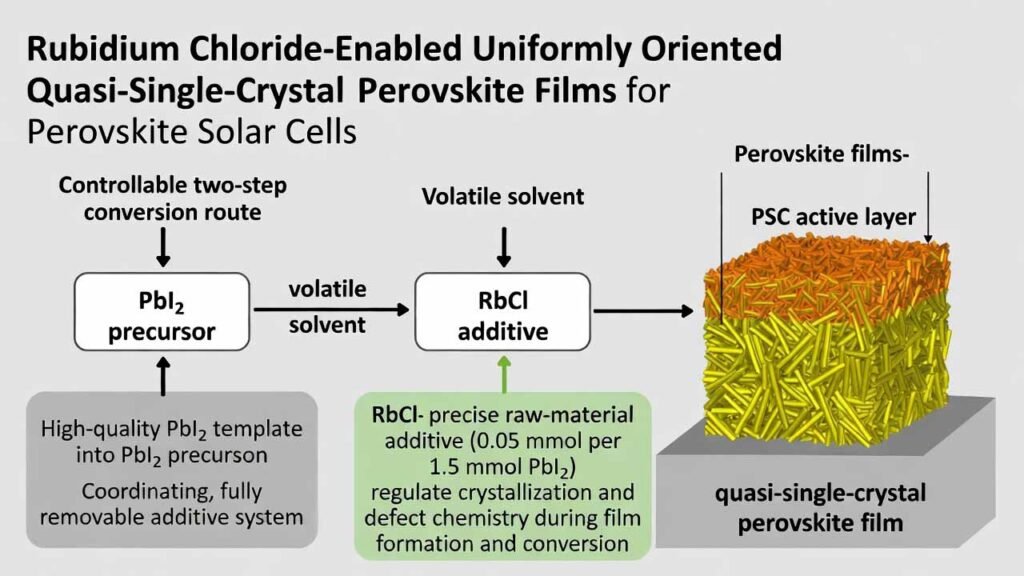
Rubidium Chloride–Enabled Uniformly Oriented Quasi-Single-Crystal Perovskite Films for Perovskite Solar Cells
1) Overview
Uniform orientation and high crystallinity in perovskite absorber layers are decisive for charge transport, interfacial extraction, and long-term device stability in perovskite solar cells (PSCs). A controllable two-step conversion route can be achieved by coordinating PbI2 with a volatile solvent additive (with tunable coordination strength) and introducing an alkali salt such as rubidium chloride (RbCl) (or CsI) directly into the PbI2 precursor. This combination deliberately slows down the AX + PbI2 conversion kinetics, promotes a more complete intermediate reaction, minimizes residual PbI2 impurity phase, and enables a uniformly oriented quasi-single-crystal perovskite film suitable as the PSC active layer.
The key manufacturing idea is simple: (i) build a high-quality PbI2 template using a coordinating, fully removable (volatile) additive system, and (ii) use RbCl as a precise raw-material additive (typical level: 0.05 mmol per 1.5 mmol PbI2) to further regulate crystallization and defect chemistry during film formation and conversion.
2) Detailed Experimental Procedure
-
Substrate cleaning (transparent conductive substrate: FTO or ITO on glass)
- Ultrasonicate sequentially in glass cleaner, deionized water, and ethanol for 15 min each.
- Plasma-clean for 10 min. Dry and store in a clean environment.
-
Electron transport layer (ETL) deposition (SnO2)
- Deposit SnO2 via spin-coating of a SnO2 nanoparticle colloid solution, or prepare by chemical bath deposition (CBD).
- Dry/anneal per your established SnO2 process window to form a compact ETL.
-
PbI2 precursor solution with volatile coordinating additive + RbCl
Organic mixed solvent: DMF (N,N-dimethylformamide) + one volatile additive chosen from: N,N-dimethylacryloyl urea, methyl phenyl sulfoxide, ethylene sulfonyl ethane (use at least one).
- Typical formulation (1 mL total solvent): additive + DMF.
- Solute loading: PbI2 1.5 mmol + RbCl 0.05 mmol (or CsI 0.05 mmol).
- Additive-to-PbI2 molar ratio: 0.3–1.3 : 1 (often strong performance around ~0.5 : 1).
- Heat and stir until fully dissolved and optically uniform.
Practical note for R&D: keep RbCl low-moisture and low-alkali contamination (Na/K) to protect reproducibility, and weigh/dispense precisely because the additive level is small but highly process-sensitive.
-
Step 1 coating: PbI2 film formation
- Transfer ETL-coated substrates to a controlled environment (e.g., glovebox) for coating.
- Dispense 20 μL PbI2 solution onto the substrate.
- Spin-coat: acceleration 2000 rpm/s, speed 2000 rpm, time 30 s.
- Soft-heating: 50–75°C for 0.5–2 min (example condition: 70°C for ~40 s) to form a PbI2 film.
-
Organic ammonium salt solution (AX) preparation
- Dissolve at least one of: formamidinium iodide (FAI), methylammonium chloride (MACl), methylammonium iodide (MAI) in isopropanol (IPA).
- Example formulation: FAI 0.5 mmol + MACl 0.2 mmol in 1 mL IPA; stir until fully dissolved.
-
Step 2 conversion: perovskite film formation + additive removal
- Cool the PbI2 film to room temperature.
- Dispense 100 μL AX solution onto the PbI2 film.
- Spin-coat: acceleration 2000 rpm/s, speed 2000 rpm, time 30 s.
- Anneal at 135–150°C for 5–20 min (example condition: 150°C for 10 min) to complete conversion and ensure the volatile additive fully evaporates.
- Optional process control: perform this step in a controlled ambient (example: ~35% RH air) if your line is designed for that window.
-
Optional quasi-2D passivation layer (for interface stabilization)
- Prepare an aromatic/alkyl ammonium salt AX in IPA (A can be phenethylammonium, phenylpropylammonium, phenylbutylammonium, n-hexylammonium, n-octylammonium; X can be I−, Br−, or Cl−).
- Example: 10 mM phenylbutylammonium bromide in IPA, dispense 100 μL, spin at 4000 rpm for 30 s (acceleration 4000 rpm/s).
-
Hole transport layer (HTL) and top electrode (typical PSC stack)
- Prepare Spiro-OMeTAD HTL solution (example: 72.3 mg Spiro-OMeTAD in 1 mL chlorobenzene + tBP + LiTFSI solution), then spin-coat 30 μL at 4000 rpm for 30 s.
- Thermally evaporate Au electrode: vacuum ~5×10⁻⁴ Pa, rate 2 Å/s, thickness 80 nm.
Device stacks may be configured as: substrate/ETL/perovskite/quasi-2D passivation/HTL/metal, or substrate/HTL/quasi-2D passivation/perovskite/ETL/metal, depending on your architecture.
3) Process Comparison vs. Conventional Routes
| Dimension | Conventional One-Step | Conventional Two-Step (typical) | Volatile Additive + RbCl–Assisted Two-Step (this workflow) |
|---|---|---|---|
| Reaction control | Fast crystallization; narrow window | Often uncontrolled AX + PbI2; incomplete conversion | Coordinating additive reduces PbI2 reactivity; delayed kinetics enables fuller intermediate reaction |
| Residual PbI2 | Can occur if solvent/antisolvent timing is off | Common issue; PbI2 impurity phase remains inside film | Strongly suppressed; PbI2 impurity reduced/disappears with optimized conditions |
| Orientation / texture | Often polycrystalline, mixed orientation | Random orientation is frequent | Uniformly oriented quasi-single-crystal film achievable |
| Additive side effects | Residuals can cause traps if not controlled | Organic additives may induce low-dimensional phases that impede carrier transport | Additive is volatile and fully removed during anneal; avoids persistent parasitic phases |
| Device outcomes (typical trend) | Good peak efficiency possible, but reproducibility can be sensitive | Fill factor and stability limited by defects/residual PbI2 and poor texture | Higher fill factor and stability; reported small-area devices reaching >26.8% and ~27.05% with strong high-T/high-RH aging resistance (e.g., 85°C/50% RH for ~1000 h with minimal decay under optimized conditions) |
4) Why Rubidium Chloride (RbCl) Is a High-Value Raw Material in This Application
In this workflow, RbCl is not a generic “salt additive”; it is a precision raw material used to steer nucleation, conversion, and defect formation during the PbI2-to-perovskite transformation. At low dosage (example: 0.05 mmol RbCl per 1.5 mmol PbI2, ~3.3 mol% vs PbI2), RbCl can help produce a cleaner, better-oriented absorber by influencing the precursor chemistry and the solid-state conversion pathway.
- Crystallization tuning and morphology improvement: Rb+ introduction alongside a coordinating, volatile additive system can promote smoother PbI2 templating and more uniform conversion, aligning with larger-grain, higher-crystallinity films.
- Defect and impurity-phase suppression: A major pain point in conventional two-step processing is residual PbI2 and poor crystal quality. RbCl-assisted precursor engineering supports more complete reaction between AX species and PbI2 intermediate phases, reducing PbI2 remnants and associated recombination centers.
- Orientation control without “permanent additives”: Unlike strategies that rely on non-volatile additives which can remain in the film and create transport barriers, this approach removes the volatile additive during annealing while retaining the structural benefit; RbCl helps achieve the target microstructure without forcing persistent low-dimensional parasitic phases.
- Device-level benefits tied to film quality: Uniform orientation and reduced defect density translate into improved charge transport and extraction, typically observed as higher fill factor and enhanced operational stability, including under harsh aging conditions (high temperature and humidity).
- Engineering-friendly dosing and scale-up compatibility: Because RbCl is introduced directly in the PbI2 precursor, it integrates cleanly with spin coating, slot-die, blade coating, or spray coating workflows. Dosing is straightforward: control by molar ratio and keep moisture/ionic contamination tightly specified for reproducible manufacturing.
RbCl raw-material checklist for R&D reproducibility: low moisture, low Na/K background, consistent particle size distribution (if solid dosing is used), and tight assay control. In perovskite processes, small impurity variations can shift crystallization kinetics and film texture—treat RbCl as a critical input, not a commodity salt. The synthesis method mentioned in this article references patent document number CN202510322689.8