
Rubidium Chloride (RbCl) for Near-Infrared Luminescent Neodymium Borate Crystals in Photonics
1) Overview
Rare-earth borates are widely explored as functional crystal hosts for photonics because boron–oxygen clusters can assemble into diverse frameworks, while rare-earth ions provide sharp f→f transitions with minimal host perturbation. The target material here is a neodymium borate near-infrared (NIR) luminescent crystal with the composition Nd(B6O13H5)·2H2O (triclinic, space group P-1). Under 520 nm excitation, Nd³⁺ produces characteristic NIR emission in the 900–1200 nm region (notably around 903 nm and 1056 nm), supporting use cases in optical communication components, NIR laser/seed sources, bio-sensing, and fluorescence-based analytical detection.
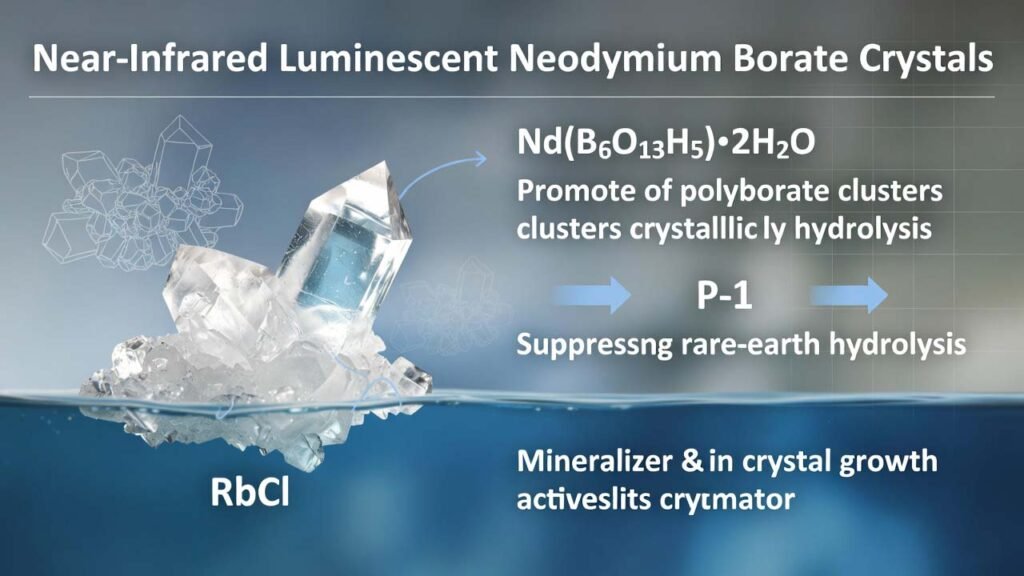
A key enabler for forming this rare-earth borate crystal under mid-temperature hydrothermal conditions is rubidium chloride (RbCl). RbCl serves as a highly soluble alkali-metal chloride additive that reshapes the solution/flux micro-environment, promoting polyborate cluster assembly and suppressing failure modes common in low-temperature rare-earth borate attempts (such as rare-earth hydrolysis and precipitation).
2) Detailed Experimental Procedure
Target product: Nd(B6O13H5)·2H2O near-infrared luminescent single crystals (typically pale-pink plate-like crystals).
Core concept: Mid-temperature hydrothermal synthesis in a PTFE-lined autoclave at 260 °C under autogenous pressure, with RbCl as an activator/mineralizer.
2.1 Reagents and Molar Ratio
Use a boric acid / neodymium nitrate / rubidium chloride molar ratio of: H3BO3 : Nd(NO3)3·6H2O : RbCl = 20 : 1 : 1
| Component | Typical Amount (Example Batch) | Role in Reaction |
|---|---|---|
| Boric acid (H3BO3) | 10 mmol | Polyborate source; forms B–O clusters that assemble into 1D chain motifs in the final structure. |
| Neodymium nitrate hexahydrate (Nd(NO3)3·6H2O) | 0.5 mmol | Nd³⁺ luminescent center; coordinates with oxygen atoms to stabilize the borate framework. |
| Rubidium chloride (RbCl) | 0.5 mmol | Activator/mineralizer: adjusts ionic strength and local chemistry to favor rare-earth borate crystallization; promotes polyborate formation without forming insoluble Nd precipitates. |
| Deionized water | 1.0 mL (workable range 1–2 mL) | Reaction medium; enables partial dissolution and transport, allowing controlled nucleation and crystal growth. |
2.2 Hydrothermal Setup and Reaction
- Charge the liner: Add H3BO3, Nd(NO3)3·6H2O, RbCl, and deionized water into a 10 mL PTFE (Teflon) liner. Mix thoroughly until a uniform slurry/mixture is obtained.
- Seal the autoclave: Place the PTFE liner into the stainless-steel autoclave body and seal. The process runs under autogenous pressure generated by internal air and water vapor at temperature.
- Hydrothermal reaction: Heat at 260 °C for 72 hours (3 days). During heating, boric acid and neodymium nitrate hydrate can form a reactive melt/solution phase, while the small amount of water (added water plus dehydration/condensation water) dissolves RbCl and drives the chemistry toward polyborate assembly and rare-earth coordination.
- Controlled cooling: After completion, cool the autoclave to room temperature naturally. Crystal nucleation and growth finalize during cooling, yielding well-defined crystals.
2.3 Product Recovery and Handling
- Open and decant: Open the vessel after it reaches room temperature. Carefully decant the mother liquor.
- Collect crystals: Retrieve the crystals (typically regular, pale-pink plate-like crystals).
- Rinse: Rinse quickly with a small amount of deionized water to remove residual soluble salts, then optionally rinse with ethanol to aid drying.
- Dry: Air-dry at room temperature or dry gently under low heat as needed. The crystals are reported to be stable in air (non-deliquescent) and insoluble in water.
2.4 Recommended Characterization (R&D Checklist)
- Powder XRD: Confirm phase purity by matching experimental peaks with the simulated/reference pattern (commonly evaluated across 5–45° 2θ).
- IR spectroscopy: Verify functional group/cluster signatures (e.g., OH stretching near ~3500 cm⁻¹; BO3 and BO4 region features).
- Photoluminescence (PL): Under 520 nm excitation, check for Nd³⁺ NIR emission peaks around 903 nm and 1056 nm (900–1200 nm window).
- Single-crystal XRD (optional but ideal): Resolve detailed structure, including the B6 oxygen cluster network and Nd–O coordination environment.
3) Comparison vs. Traditional Production Routes
Rare-earth borates are often produced using high-temperature solid-state routes because rare-earth ions can hydrolyze or precipitate under many low-temperature solution conditions, making crystallization difficult. The RbCl-assisted mid-temperature hydrothermal route changes that balance.
| Aspect | RbCl-Assisted Hydrothermal (This Route) | Traditional High-Temperature Solid-State |
|---|---|---|
| Typical temperature | Mid-temperature (260 °C) | High temperature (often much higher; repeated firing/calcination common) |
| Process steps | One-pot sealed reaction → natural crystallization | Mix/grind → calcine → regrind → recalcine (multi-cycle) common |
| Crystal form | High-quality crystals suitable for structural determination and optical evaluation | Often polycrystalline powders; single-crystal growth may require additional flux or separate growth steps |
| Energy use | Lower thermal budget; sealed autoclave heating | Higher energy consumption due to high-T furnaces and longer multi-stage schedules |
| Rare-earth hydrolysis risk | Reduced by ionic environment engineering (RbCl helps stabilize the reaction pathway toward borate crystallization) | Not applicable (solid-state), but requires high-T to force reaction completion |
| Scalability in R&D | Convenient for screening compositions/conditions (water amount, additive selection) | Slower iteration; each condition change may require full furnace cycle and reprocessing |
4) Why Rubidium Chloride (RbCl) Is Superior in This Application
In this synthesis, RbCl is not a trivial salt—it acts as a practical reaction “activator/mineralizer” that makes mid-temperature rare-earth borate crystal growth feasible and repeatable. For engineering teams optimizing yield and crystal quality, RbCl contributes in several concrete ways:
- High solubility under limited water: With only 1–2 mL of deionized water, RbCl dissolves effectively, establishing an ionic environment that supports transport, nucleation control, and sustained crystal growth rather than uncontrolled precipitation.
- Compatible with Nd³⁺ chemistry: RbCl is selected because it is unlikely to form insoluble precipitates with rare-earth ions under the intended conditions, avoiding “dead-end” solids that consume Nd³⁺ before borate crystallization can occur.
- Promotes polyborate cluster assembly: The target structure contains a B6 oxygen cluster built from BO3 triangles and BO4 tetrahedra. RbCl helps tune the reaction micro-environment so boric acid can condense into the required polyborate motifs and ultimately assemble into 1D B–O chains.
- Improves crystal quality (R&D-relevant): The route yields well-defined, stable crystals (reported as non-deliquescent in air and insoluble in water), suitable for single-crystal diffraction and reliable optical measurements—critical for photonics material development.
- Practical, cost-effective, and easy to source: RbCl offers a clean, controllable way to influence crystallization without introducing complex ligands or reactive bases, keeping the workflow simple for laboratory and pilot-scale screening.
Implementation note for process optimization: keep the H3BO3:Nd(NO3)3·6H2O:RbCl ratio fixed at 20:1:1 first, then tune only water amount within 1–2 mL and cooling profile to adjust nucleation density and crystal size distribution. The synthesis method mentioned in this article references patent document number CN202210351141.2