
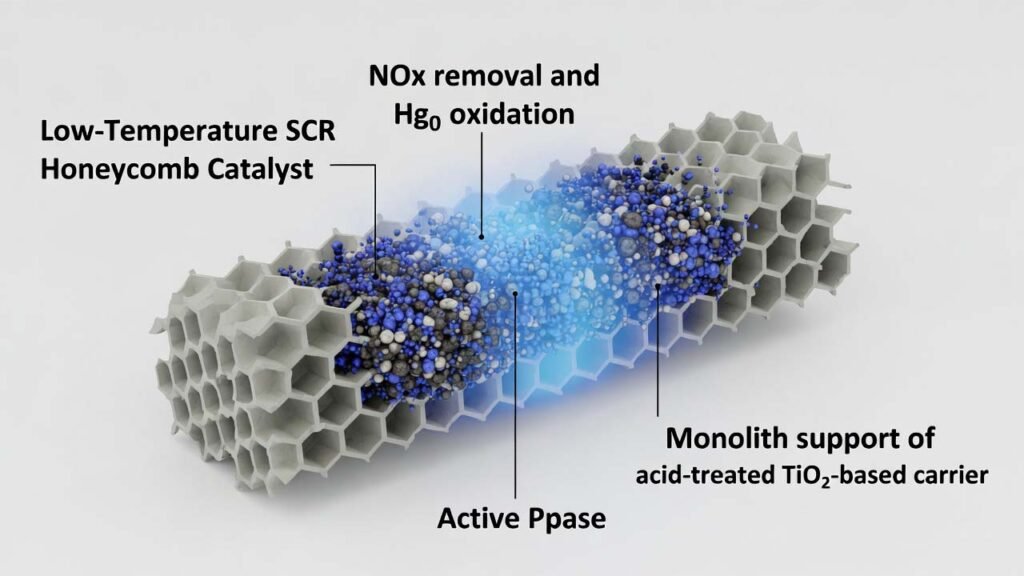
Rubidium Nitrate–Modified Low-Temperature SCR Honeycomb Catalyst for Synergistic NOx Removal & Hg0 Oxidation
1) Overview
Coal-fired flue gas often contains both nitrogen oxides (NOx) and mercury, where mercury is frequently present as elemental Hg0, a form that is difficult to capture in downstream wet scrubbing systems. A practical route to higher overall mercury capture is to promote Hg0 oxidation to water-soluble Hg2+ while maintaining strong low-temperature NOx conversion.
This process prepares a modified honeycomb SCR catalyst composed of a porous monolith support (acid-treated TiO2-based carrier) and a multi-component active phase introduced by impregnation. Rubidium nitrate (RbNO3) is incorporated directly into the carrier formulation to enhance sulfur resistance and stability under low-temperature conditions, while V–W–Mo and Mn/Ce plus trace noble-metal nitrates improve low-temperature SCR activity and Hg0 oxidation performance.
2) Detailed Experimental Procedure
2.1 Porous Honeycomb Carrier: Recommended Formulation (Parts by Weight)
| Component | Role in Carrier | Typical Range (parts) |
|---|---|---|
| Amphoteric oxide (preferably TiO2) | Primary support framework; provides SCR-relevant surface chemistry | 20–40 |
| Rubidium nitrate (RbNO3) | Alkali promoter for SO2 tolerance by moderating surface acidity/basicity | 1–5 |
| Polyethylene glycol (PEG) | Processing aid; rheology control | 2–6 |
| Sodium carboxymethyl cellulose (CMC-Na) | Thickening and binding | 2–6 |
| Triethanolamine | Thickening, binding, and dispersion support | 1–5 |
| SiO2 | Strength and structural tuning | 1–3 |
| Al2O3 | Mechanical reinforcement and thermal stability | 5–10 |
| CaO | Strength/plasticity adjustment | 1–5 |
| Quartz fiber | Improves stability and corrosion resistance | 0.1–3 |
| Soybean oil | Extrusion lubrication | 1–3 |
| Water | Paste formation | 15–20 |
2.2 Active-Phase Impregnation Solution: Recommended Formulation (Parts by Weight)
| Component | Function in Catalyst | Typical Range (parts) |
|---|---|---|
| Ammonium metavanadate | V-based SCR activity component | 2–6 |
| Ammonium metatungstate | W-based promoter; supports SCR stability | 1–5 |
| Ammonium molybdate tetrahydrate | Mo promoter for low-temperature activity and sulfur resistance | 0.1–3 |
| Oxalic acid | Complexation/solubilization aid for precursor preparation | 5–10 |
| Manganese nitrate | Enhances denitrification and mercury oxidation ability | 0.1–3 |
| Cerium nitrate | Promotes oxidative pathways beneficial to Hg0 conversion and SCR activity | 0.1–3 |
| Palladium nitrate | Trace noble-metal oxidation promoter for Hg0 | 0.2–6 |
| Platinum nitrate | Trace noble-metal oxidation promoter for Hg0 | 0.2–6 |
| Alkylphenol polyoxyethylene ether | Active-phase dispersant for more uniform impregnation | 0.5–6 |
| Water | Solvent | 5–10 |
2.3 Step-by-Step Preparation
A. Acid Treatment of the TiO2 Support
- Add TiO2 to an HCl solution (typically 1–10 mol/L).
- Maintain acidification at 10–50 °C for 1–10 hours with agitation.
- Filter to obtain acid-treated TiO2.
B. Kneading and Paste Preparation (Carrier with RbNO3)
- Combine acid-treated TiO2 with RbNO3, PEG, CMC-Na, triethanolamine, SiO2, Al2O3, CaO, soybean oil, quartz fiber, and water per the formulation range above.
- Knead in a mixer at 200–300 rpm for 20–40 minutes to form a uniform extrusion-ready paste.
C. Extrusion Shaping (Honeycomb Wet Green Body)
- Feed the kneaded paste into an extruder.
- Extrude into a porous honeycomb monolith geometry to obtain a wet green body.
D. Drying of the Honeycomb Carrier
- Place the wet green body in a drying oven.
- Dry at 100–120 °C using a controlled ramp to minimize cracking, holding for 10–20 hours.
E. Calcination to Obtain the Final Porous Carrier
- Calcine the dried carrier at 300–500 °C for 20–30 hours.
- Cool to ambient temperature to obtain the porous honeycomb carrier that already contains RbNO3-derived rubidium species after thermal treatment.
F. Preparation of the Active-Phase Impregnation Solution
- Add water to a reactor vessel, then add ammonium metavanadate, ammonium metatungstate, ammonium molybdate tetrahydrate, and oxalic acid.
- Add alkylphenol polyoxyethylene ether and stir until all solids dissolve, keeping the solution at 20–80 °C as needed for dissolution.
- Stop heating, then add manganese nitrate, cerium nitrate, palladium nitrate, and platinum nitrate; continue stirring until fully dissolved.
- Age (stand) the impregnation solution for 1–3 hours.
G. Impregnation of the Honeycomb Carrier
- Immerse the porous honeycomb carrier into the impregnation solution.
- Maintain impregnation at 20–30 °C for 10–20 hours.
H. Post-Impregnation Drying and Final Calcination
- Dry the impregnated honeycomb at 100–120 °C for 1–10 hours.
- Calcine at 100–300 °C for 1–10 hours to obtain the final low-temperature SCR honeycomb catalyst.
Acidify TiO2 in 10 mol/L HCl at 25 °C for 6 h; knead at 300 rpm for 35 min; dry at 120 °C for 12 h; calcine carrier at 500 °C for 20 h; impregnate after preparing V–W–Mo and nitrate solution; dry at 120 °C for 3 h; final calcine at ~260 °C for ~8 h.
3) Comparison vs. Conventional SCR Catalyst Production
Conventional approach (typical V-based commercial honeycomb catalysts)
- Often optimized for 300–400 °C operation; low-temperature (200–300 °C) activity can drop in realistic flue gas.
- Hg0 oxidation can be insufficient at lower temperatures, limiting overall mercury capture downstream.
- High SO2 and particulate environments can suppress Hg0 oxidation and accelerate deactivation (poisoning), shortening service life.
This production route (acid-treated carrier + RbNO3 + multi-component impregnation)
- Introduces a carrier design and promoter set aimed specifically at low-temperature NOx conversion with concurrent Hg0 oxidation.
- Uses Mo-promoted chemistry and dispersant-assisted impregnation to improve distribution of active components and extend the effective temperature window.
- Includes RbNO3 in the carrier to reduce SO2 adsorption tendency and improve sulfur tolerance, supporting longer catalyst lifetime under sulfur-containing flue gas.
- Combines Mn/Ce and trace noble-metal nitrates to strengthen oxidation pathways relevant to Hg0 conversion while maintaining SCR performance.
Under a representative lab flue-gas condition (including NO, O2, SO2, Hg, and N2 balance at an SCR-relevant space velocity), the prepared catalyst system is reported to achieve high NOx conversion alongside Hg0 oxidation efficiency above 91%, with good low-temperature activity observed even around 200 °C (conditions and results depend on formulation and processing).
4) Why Rubidium Nitrate (RbNO3) Improves This Application
In low-temperature SCR and mercury control, SO2 exposure can strongly suppress activity and accelerate deactivation. Rubidium nitrate is used here as a carrier-level promoter because it directly targets that bottleneck while remaining easy to dose and distribute during paste preparation.
Key advantages of using RbNO3 as a raw material
- Enhanced SO2 tolerance: Rubidium (Rb+) exhibits strong basicity, helping neutralize overly acidic surface sites and suppress SO2 adsorption, which supports stable low-temperature operation in sulfur-containing flue gas.
- Carrier-level promotion (not just surface doping): Adding RbNO3 during kneading embeds rubidium uniformly throughout the carrier matrix; after thermal treatment, rubidium-derived species can remain well-dispersed and resistant to washout, supporting longer-term stability.
- Processing compatibility: RbNO3 integrates into the same extrusion-grade paste used to form honeycomb monoliths, enabling scalable manufacturing without introducing additional complex deposition steps.
- Synergy with multi-metal active phases: With SO2 adsorption suppressed, the V–W–Mo and Mn/Ce (plus trace Pt/Pd) active components can maintain higher effective utilization at low temperature, supporting both SCR activity and Hg0 oxidation pathways.
Rubidium nitrate is typically handled as an oxidizing inorganic salt. Store sealed and dry, avoid contamination with reducing agents/organics beyond the intended formulation, and follow your site EHS controls for oxidizers and nitrate-containing waste streams. The synthesis method mentioned in this article references patent document number CN202510834405.3