
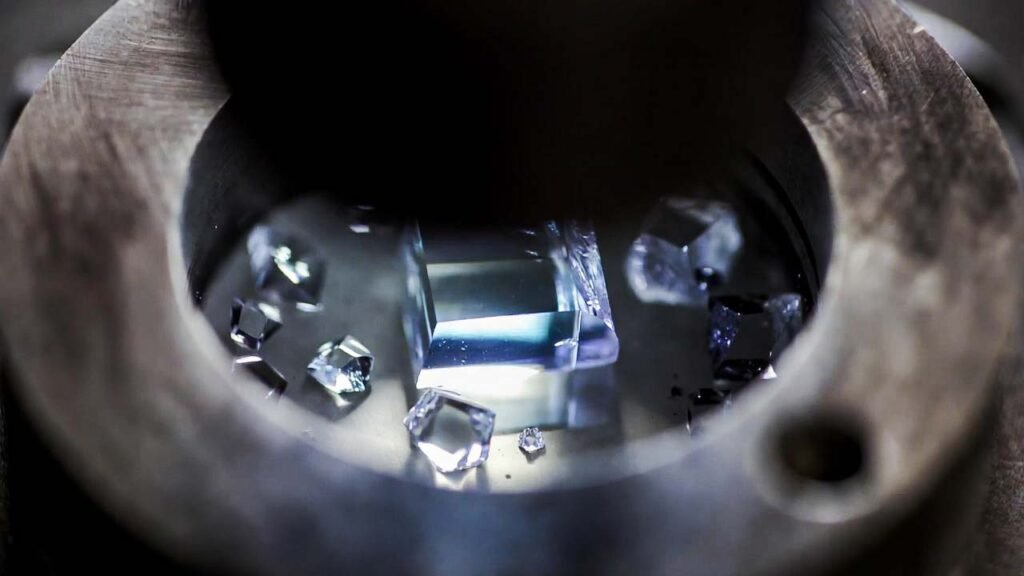
Rubidium Nitrate in UV Nonlinear Optics: Step-by-Step Growth of Rb3B6O10NO3 Crystals for Solid-State Laser Harmonic Generation
1) Overview
Mixed-anion borate–nitrate crystals are a practical pathway for extending laser frequency conversion into the UV, especially where wide transmission and UV cutoff are critical. The compound Rb3B6O10NO3 (rubidium boron nitrate) is reported as a trigonal non-linear optical (NLO) crystal with a UV cutoff edge below 300 nm (deep-UV behavior is reported around ~216 nm) and a second-harmonic generation (SHG) response on the order of ~0.2× that of KDP. It can be used for harmonic generation of Nd:YAG laser outputs (1064 nm fundamental to 2nd/3rd/4th harmonics), supporting compact all-solid-state UV sources.
In this workflow, rubidium nitrate (RbNO3) is a key feedstock because it is simultaneously: (1) the only explicitly defined nitrate (NO3−) source for building the mixed-anion framework, and (2) a rubidium (Rb+) contributor that helps lock stoichiometry and phase formation when paired with boron–oxygen precursors. For R&D and process scale-up, nitrate incorporation control is often the difference between phase-pure powder and mixed phases that limit UV transmission and device yield.
2) Detailed Experimental Procedure
A. Compound Synthesis (Choose One): Solid-State Synthesis (Open Crucible)
-
Raw material selection (target molar ratio Rb : B : N = 3 : 6 : 1):
- Rb-bearing precursor: RbF, RbOH, Rb2CO3, RbNO3, Rb2B4O7, RbHCO3, or RbBF4
- B-bearing precursor: H3BO3 and/or B2O3
- N-bearing precursor: RbNO3 (nitrate source)
- Homogenize the mixture thoroughly, load into a ceramic crucible.
- Stage-1 reaction (low-temperature pre-reaction): heat in a muffle furnace to 200–300 °C, hold for 10–80 h. During the hold, remove and grind 3 times to improve mixing and obtain compositionally uniform powder.
- Stage-2 reaction (phase formation): return powder to a ceramic crucible and heat to 340–560 °C, hold for 24–120 h.
- Output: phase-formed compound powder Rb3B6O10NO3.
- 6RbF + 20H3BO3 + 3RbNO3 → 3Rb3B6O10NO3 + 2BF3↑ + 30H2O↑
- Rb2CO3 + 6H3BO3 + RbNO3 → Rb3B6O10NO3 + CO2↑ + 9H2O↑
- 2RbOH + 6H3BO3 + RbNO3 → Rb3B6O10NO3 + 10H2O↑
B. Compound Synthesis (Choose One): Vacuum-Encapsulated Synthesis (Sealed Quartz Tube)
- Raw material selection (target molar ratio Rb : B : N = 3 : 6 : 1, with RbNO3 as the nitrate source), then mix uniformly.
- Load the mixture into a quartz tube, evacuate to 1×10⁻³ Pa, and seal at high temperature.
- Stage-1 vacuum pre-reaction: place sealed tube into a muffle furnace and heat at 5–30 °C/h to 200–300 °C; hold for 24–120 h.
- Open, grind, reload, evacuate to 1×10⁻³ Pa, reseal; repeat the Stage-1 cycle 2–5 times to obtain a uniform powder.
- Stage-2 vacuum phase formation: load uniform powder into a quartz tube, evacuate to 1×10⁻³ Pa, seal; heat at 5–30 °C/h to 340–560 °C; hold for 24–120 h.
- Output: high-uniformity compound powder Rb3B6O10NO3.
Practical note for tube processes: the workflow explicitly uses vacuum sealing to minimize volatility-driven composition drift during heating, which is especially relevant when nitrate participation and borate network formation must stay stoichiometric for UV-grade material.
C. Single-Crystal Growth (Choose One): Vacuum-Encapsulated Crystal Growth
- Prepare starting powder using a compound synthesis route above (uniformity matters for stable nucleation and growth).
- Mix Rb-bearing, B-bearing, and N-bearing precursors at Rb : B : N = 3 : 6 : 1 (with RbNO3 providing nitrate), load into a quartz tube.
- Evacuate to 1×10⁻³ Pa, seal; place into a muffle furnace and heat at 5–30 °C/h to 400–550 °C. Hold for 30–120 h.
-
Controlled cooling schedule:
- Cool at 0.1–3 °C/h to 350–360 °C
- Then cool at 3–5 °C/h to 250–260 °C
- Finally cool at 10–30 °C/h to room temperature
- Output: Rb3B6O10NO3 NLO single crystals suitable for orientation cutting and device evaluation.
D. Single-Crystal Growth (Choose One): Flux (Solvent-Assisted) Growth
- First prepare compound powder Rb3B6O10NO3 via solid-state or vacuum-encapsulated synthesis.
- Blend compound + flux by the stated molar proportion 0.5–5 : 0.1–10, grind to homogenize.
- Load into a quartz tube, evacuate to 1×10⁻³ Pa, seal; heat to 340–560 °C and hold 30–120 h.
- Cool at 0.1–3 °C/h to 250–260 °C, then 10–30 °C/h to room temperature to complete growth.
- Flux options include: RbF, H3BO3, B2O3, PbO, RbBF4, PbF2.
Flux growth is typically selected when you want to broaden growth windows, adjust supersaturation behavior, and improve crystal size/quality at controlled cooling rates.
3) Comparison Summary: This Production Route vs “Traditional” Routes
For UV NLO materials, “traditional” in-lab routes often mean open-system solid-state synthesis or solution growth (e.g., KDP family), while device crystals may also be grown from melts or fluxes without strict atmosphere control. The workflow here adds a strong focus on vacuum encapsulation and nitrate-controlled mixed-anion chemistry, which changes both purity control and reproducibility.
| Aspect | Open Solid-State (Common Traditional Baseline) | Vacuum-Encapsulated / Sealed-Tube Route (This Workflow) |
|---|---|---|
| Stoichiometry control | More sensitive to volatility and atmosphere; easier to drift in mixed-anion systems | Better control by limiting volatilization-driven composition shift; improved batch repeatability |
| Powder uniformity | Relies mainly on periodic grinding; phase purity can be inconsistent across batches | Explicit multi-cycle grind + reseal steps (2–5 cycles) to enforce homogeneous precursors |
| Crystal growth control | Often broader, less constrained temperature programs | Defined heating/cooling rates (down to 0.1 °C/h) to manage nucleation and growth stability |
| UV-grade quality focus | Impurity and defect control can be harder in open systems | Process is structured to reduce contamination and maintain mixed-anion integrity for UV transmission |
| Scale-up practicality | Simpler equipment, but reproducibility may suffer for mixed-anion UV crystals | More procedural steps, but typically better for consistent phase formation and growth reproducibility |
4) Why Rubidium Nitrate (RbNO3) Is the Advantage Feedstock Here
- It is the nitrate builder for the mixed-anion framework. The target material is a borate–nitrate compound; without a controlled nitrate source, the intended NO3− incorporation becomes unreliable. In the provided recipes, RbNO3 is explicitly the N-bearing reagent across synthesis and growth routes.
- It supports phase purity and UV transmission outcomes. In UV NLO crystals, phase impurities and unintended anion deficiencies can introduce absorption and scattering centers. Consistent nitrate delivery (stoichiometry + purity) is a direct lever for producing compositionally correct Rb3B6O10NO3.
- It integrates naturally with multiple Rb precursors. The workflow allows different Rb sources (RbF/RbOH/Rb2CO3/RbBF4/Rb2B4O7), yet keeps RbNO3 as the fixed nitrate anchor. This flexibility is useful when optimizing cost, handling, or impurity profiles without sacrificing nitrate control.
- It improves reproducibility in sealed-tube processing. Vacuum encapsulation is repeatedly used at 1×10⁻³ Pa, with staged temperature programs. Using high-purity, low-moisture rubidium nitrate helps stabilize the nitrate contribution during these long holds and controlled cool-down steps.
- It maps cleanly to laser-harmonic applications. The end goal is device-grade crystals for harmonic conversion (e.g., 1064 nm → 532/355/266 nm). For this application, raw material purity and anion stoichiometry are not “nice-to-have”; they are strongly coupled to optical loss, UV cutoff behavior, and usable conversion efficiency.
Procurement tip for R&D-scale reproducibility: specify rubidium nitrate for UV optics work as low moisture / low insolubles, and tightly controlled Na/K and halides, since trace contaminants can translate into growth defects and UV absorption tails in deep-UV-facing crystals.
Keywords for indexing: rubidium nitrate, RbNO3, mixed-anion borate nitrate, Rb3B6O10NO3, UV nonlinear optical crystal, vacuum encapsulation crystal growth, Nd:YAG harmonic generation, deep-UV frequency conversion.The synthesis method mentioned in this article references patent document number CN202110080500.0