
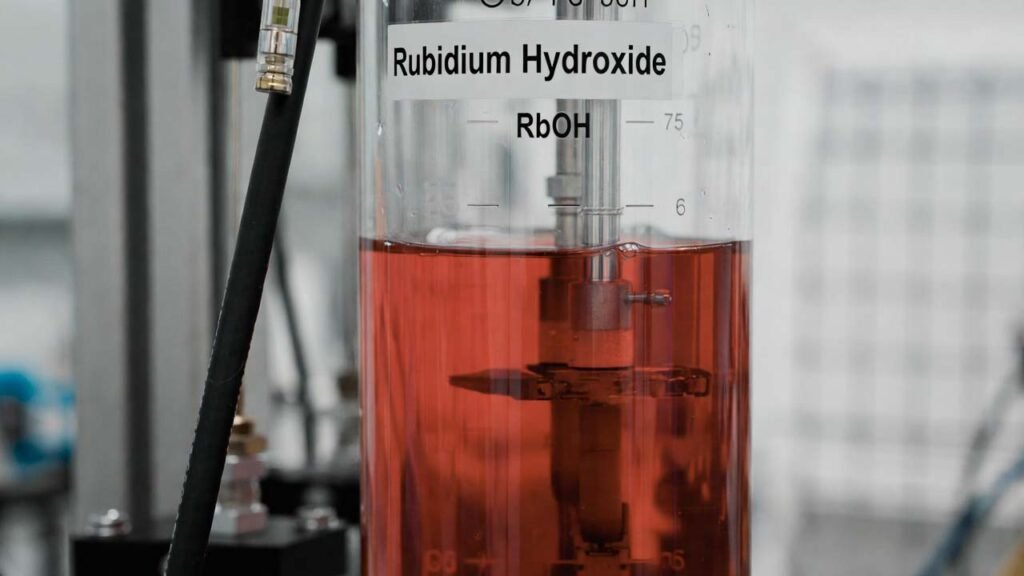
Rubidium Hydroxide (RbOH) in Vanadium Redox Flow Batteries: Stabilizing High-Concentration Negative Electrolytes
1) Overview
Vanadium redox flow batteries (VRFBs) are widely used for large-scale energy storage because power and capacity can be designed independently, response is fast, and long cycle life is achievable. A core limiter for higher energy density is electrolyte stability—especially on the negative side when operating with high vanadium concentrations.
In typical VRFB chemistry, the negative electrolyte (V(II)/V(III) in sulfuric acid) does not directly generate or consume H+ in the main reaction. However, during extended cycling, H+ can migrate from the positive side (where H+ participates) to the negative side via crossover, diffusion, and side reactions. When H+ accumulates in the negative electrolyte, V(III) becomes less stable at high acidity and may precipitate, which reduces capacity and can clog felt electrodes, channels, and piping.
A practical way to restore stability is to add a soluble alkaline agent that is compatible with the sulfuric-acid vanadium electrolyte system and does not form precipitates. Rubidium hydroxide (RbOH) is one option in this alkaline set; it supplies strong, fast neutralization via OH− while keeping added species fully soluble in sulfate media (rubidium salts remain soluble under typical VRFB acid ranges).
2) Detailed Experimental Process
Goal: When the negative electrolyte becomes over-acidified during cycling, dose a controlled amount of rubidium hydroxide to reduce H+ back toward the initial level, thereby improving V(III) stability and preventing precipitation.
This workflow is written for R&D and engineering use. Adapt sampling frequency, analytical method, and dosing hardware to your VRFB platform and safety standards.
A. Materials and electrolyte definitions
-
Negative electrolyte (high concentration): V(II) and/or V(III) in sulfuric acid solution.
- Vanadium ion concentration: 1.6–4.0 mol/L (commonly 2.0–3.0 mol/L)
- H2SO4 concentration: 0.5–3.0 mol/L (commonly 1.0–2.5 mol/L)
-
Positive electrolyte (for full-cell operation): V(IV) and/or V(V) in sulfuric acid solution.
- Vanadium ion concentration: 1.0–4.0 mol/L (commonly 2.0–3.0 mol/L)
- H2SO4 concentration: 0.5–3.0 mol/L (commonly 1.0–2.5 mol/L)
- Alkaline dosing reagent: Rubidium hydroxide (RbOH), prepared as an aqueous solution suitable for controlled addition. In the described alkaline-agent set, soluble alkaline solutions are typically in the 20–35 wt% range.
B. Instrumentation and monitoring
- H+ concentration measurement of the negative electrolyte during cycling (recommended via acid-base titration against a standard base, with temperature control and appropriate vanadium redox handling). A pH probe alone is usually insufficient at these high acid/ionic strengths.
- Electrolyte volume tracking (needed for dosing calculations).
- Stirring/mixing capability in the negative tank to avoid local high-pH zones during dosing.
- Optional: conductivity measurement to ensure acidity is not over-corrected (excess neutralization can reduce conductivity and performance).
C. Trigger condition (when to add RbOH)
Define the initial negative-electrolyte H+ concentration as [H+]0. After the battery has run for a period of time, measure the current value [H+]t.
Initiate dosing when: [H+]t > [H+]0 + (0.8–4.0) mol/L (commonly controlled in the tighter window of +0.8–2.0 mol/L, or even +0.8–1.0 mol/L for stricter stability).
D. Dosing calculation (OH− requirement)
To avoid under-dosing (continued precipitation risk) or over-dosing (acidity too low → conductivity loss and performance impact), calculate a controlled OH− target:
ΔH = [H+]t − [H+]0
Target OH− (mol/L of electrolyte) = ΔH − A
A = 0 to 0.8 mol/L
Choose A based on your desired safety margin so the corrected acidity lands between the initial value and [H+]0 + 0.8 mol/L. Multiply the target (mol/L) by the negative-electrolyte volume (L) to obtain total moles of OH−.
E. Controlled addition procedure (RbOH as the alkaline agent)
- Baseline setup: Prepare VRFB positive/negative electrolytes within the target ranges (e.g., 2–3 mol/L vanadium, 1–2.5 mol/L sulfuric acid) and record [H+]0 for the negative electrolyte before cycling.
- Cycle operation: Run the VRFB under your standard charge/discharge protocol. Track cycle count and operating temperature.
- Periodic sampling: At defined intervals (e.g., every 50–100 cycles, or based on observed drift), measure negative-electrolyte [H+]t. Watch for early signs of V(III) instability (haze, solids, increasing pressure drop/flow reduction).
- Trigger: If [H+]t exceeds the threshold above [H+]0, calculate the OH− requirement using the equation in Section D.
- Prepare RbOH solution: Use an aqueous rubidium hydroxide solution suitable for metered dosing (commonly aligned to the soluble-alkaline range, e.g., 20–35 wt%, if compatible with your dosing system). Confirm solution concentration and temperature.
- Metered dosing under mixing: Add RbOH solution slowly to the negative tank under strong mixing to prevent localized high pH. Avoid direct dosing onto felt surfaces without circulation.
- Verification: After mixing equilibrates, re-measure negative-electrolyte H+ concentration. Target: [H+]0 ≤ [H+] and [H+] < [H+]0 + 0.8 mol/L.
- Resume cycling: Continue battery operation. Maintain the monitoring cadence and repeat dosing only when the trigger condition is met.
F. Example operating point using RbOH (high-concentration case)
Electrolyte composition: vanadium ion concentration 3.0 mol/L, sulfuric acid concentration 1.8 mol/L (both sides), with positive/negative electrolyte volumes of 200 mL each.
Observation: after 70 cycles, negative [H+] measured at 5.5 mol/L. Add an appropriate amount of rubidium hydroxide to reduce [H+] to 4.0 mol/L, then continue cycling.
Result: after 200 cycles, negative [H+] measured at 4.8 mol/L, and the cell continues operating without obvious performance decay.
Practical note: these efficiencies are strongly dependent on current density, temperature, membrane type, and system design. Use them as a process illustration for acidity correction timing rather than as universal performance targets.
3) Comparison Summary: This Method vs. Traditional Approaches
| Topic | Traditional handling of negative-electrolyte instability | In-operation acidity correction with soluble alkaline agent (RbOH option) |
|---|---|---|
| Root cause addressed | Often treats symptoms (operate at lower vanadium concentration, shorten maintenance interval, replace electrolyte) rather than directly correcting H+ accumulation during run. | Directly counteracts H+ buildup from crossover/side reactions by restoring acidity toward the initial setpoint. |
| Response speed | Slow (maintenance downtime, flushing, electrolyte rebalancing) or passive (membrane optimization) with delayed impact. | Fast chemical correction; dosing can bring H+ back toward target within a short time after detection. |
| Control and scalability | Coarse control; may require conservative electrolyte design to avoid precipitation at the cost of energy density. | Quantitative dosing based on measured [H+] and volume; suitable for automation (sensor + dosing pump + mixing). |
| Risk of solids/precipitation | Precipitation risk increases if H+ continues to rise (V(III) instability), potentially causing clogging and capacity loss. | Uses a soluble alkaline agent; when properly dosed and mixed, avoids introducing insoluble byproducts and reduces V(III) precipitation risk. |
| Impact on performance | Instability can force lower concentration operation or cause degradation via solids and flow restriction. | Prevents over-acidification; careful dosing avoids over-neutralization that could reduce conductivity. |
4) Why Rubidium Hydroxide (RbOH) is Advantageous in This Application
Among soluble alkaline reagents compatible with sulfuric-acid vanadium electrolytes, rubidium hydroxide offers a combination of high basicity, full solubility, and clean neutralization chemistry—making it suitable as a corrective raw material when negative-electrolyte acidity drifts upward during VRFB operation.
- Strong and rapid H+ correction: RbOH delivers OH− efficiently, enabling quick restoration of acidity after a trigger event—important for preventing V(III) precipitation in high-concentration negative electrolytes.
- Compatibility with sulfate media: Rubidium forms soluble sulfate salts under typical operating acidities, helping maintain a precipitation-free electrolyte when dosing is properly controlled and mixed.
- Process control is straightforward: Dosing can be calculated from measured H+ drift and electrolyte volume; metered addition reduces variability and supports automation at pilot and commercial scale.
- Reduced “secondary chemistry” burden: Using a clean inorganic base like RbOH avoids introducing volatile components (e.g., ammonia loss) and avoids insoluble hydroxide residues that could arise from poorly soluble alkaline sources.
- Supports high energy-density targets: By improving stability management rather than lowering vanadium concentration, RbOH-based correction helps teams explore higher vanadium molarity windows (within solubility and temperature constraints) with better operational robustness.
- Engineering-friendly implementation: Works as an in-tank corrective reagent with standard mixing and dosing hardware; the key is tight dosing to prevent over-neutralization and conductivity loss.
Safety note: Rubidium hydroxide is a strong alkali. Use appropriate chemical-resistant PPE, corrosion-compatible wetted materials, controlled dosing, and validated disposal/neutralization procedures. The synthesis method mentioned in this article references patent document number CN201711213861.8