
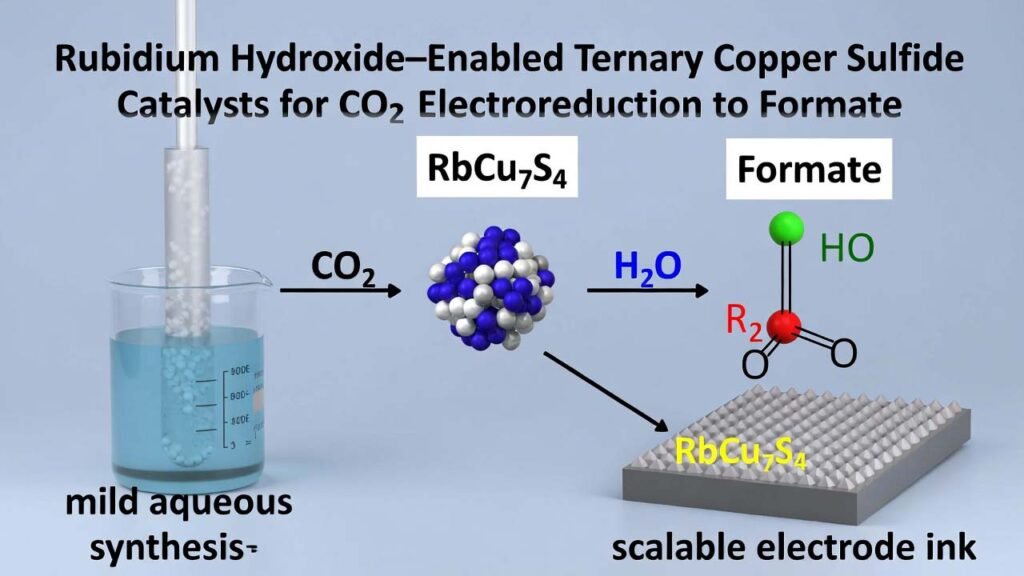
Rubidium Hydroxide–Enabled Ternary Copper Sulfide Catalysts for CO2 Electroreduction to Formate
1) Overview
Electrochemical CO2 reduction is a practical route to convert greenhouse gas into value-added chemicals. Among the possible products, formate (and formic acid after downstream conversion) is especially attractive for chemical manufacturing and as a hydrogen carrier. The main bottlenecks for copper-based catalysts are product selectivity, structural stability, and the ability to reach industrially relevant current densities without performance decay.
This workflow describes a low-temperature solution synthesis of ternary copper sulfide catalysts (M–Cu–S, M = Na, K, Rb), followed by electrode fabrication and CO2 electroreduction testing. The rubidium-containing phase (RbCu7S4) is produced by using rubidium hydroxide (RbOH) as the alkali metal source in water, enabling incorporation of Rb+ into the catalyst lattice. This helps the catalyst maintain its composition and structure during CO2 electroreduction, while improving formate selectivity and long-term stability compared with conventional copper oxides/sulfides.
2) Detailed Experimental Procedure
A. Catalyst synthesis (RbCu7S4 as the target example)
-
Prepare the alkaline precursor solution
Add rubidium hydroxide (RbOH) to ultrapure water and mix under magnetic stirring to form a uniform solution. Recommended operating window:- RbOH: 1–20 g
- Ultrapure water: 5–30 mL
- Stirring: 400–1000 rpm for 10–60 min
-
Sequentially introduce copper and sulfur precursors plus reducing agent
Under continued stirring, add the following reagents in order and ensure thorough mixing/dissolution after each addition:- Copper chloride (CuClx)
- Sodium sulfide nonahydrate (Na2S·9H2O)
- Hydrazine hydrate
- Copper chloride: 1–10 mmol
- Na2S·9H2O: 1–20 mmol
- Hydrazine hydrate: 1–5 mmol
RbOH : CuClx : Na2S·9H2O : hydrazine = 1–10 : 1–10 : 1–20 : 1–5Process control tip: Keep mixing consistent (rpm) and add reagents in the specified order to stabilize nucleation and phase formation. -
Seal and age in a water bath
Seal the vessel and maintain in a water bath to drive controlled formation of the ternary copper sulfide phase.- Temperature: 50–90 °C
- Time: 1 hour
-
Collect the product by centrifugation
After aging, collect the gray-brown product by centrifugation:- Centrifuge speed: 5000–8000 rpm
- Typical duration: ~10 min
-
Wash and dry
Wash the collected solid to remove residual ions/organics:- Wash with deionized water: 1–2 cycles
- Wash with absolute ethanol: 1–2 cycles
- 40–60 °C for 4–8 hours
B. Electrode fabrication (catalyst ink → working electrode)
-
Prepare catalyst ink
Disperse catalyst powder in ethanol containing Nafion, then ultrasonicate:- 10 mg catalyst + 1 mL ethanol + 50 μL Nafion solution
- Ultrasonication: 30 min
-
Load onto substrate
Choose the electrode format based on your test platform:- H-type cell: drop-cast 60 μL ink onto a glassy carbon electrode; dry to form the working electrode.
- Flow cell: drop-cast or spray-coat ink onto carbon paper; dry to form the working electrode.
- Glassy carbon: 0.5–1 mg·cm⁻²
- Carbon paper: 1–3 mg·cm⁻² (a commonly used value is 1 mg·cm⁻²)
C. CO2 electroreduction testing (formate/selectivity evaluation)
-
Cell setups (two common options)
- H-type cell: electrolyte 0.1 M KHCO3; counter electrode: platinum mesh/plate; reference: saturated Ag/AgCl.
- Flow cell: electrolyte 1.0 M KOH; counter electrode: nickel mesh; reference: saturated Ag/AgCl.
-
CO2 saturation
Bubble CO2 at 30 sccm for 1 hour before electrolysis to fully saturate the electrolyte. -
Electrolysis window
Perform electrolysis in the range of approximately −0.6 V to −1.4 V vs RHE, commonly in 1-hour holds per potential step. -
Product analysis
Use gas chromatography for gas products and NMR for liquid products (including formate) to determine selectivity and Faradaic efficiency.
3) Comparison Summary: This Production Route vs. Conventional Copper-Based Catalyst Routes
Conventional copper oxides/sulfides (e.g., CuO, CuS, Cu2S) often suffer from structural and compositional drift during CO2 reduction. A well-known practical issue is in situ transformation toward metallic Cu under operating conditions, which tends to promote C–C coupling pathways and can reduce formate selectivity. Many reported copper catalysts also struggle to sustain industrially relevant partial current densities for formate while keeping high Faradaic efficiency and long-term stability.
Process-wise, traditional Cu2S preparation can require specialty precursors and long processing times (for example, extended room-temperature mixing on the order of many hours), whereas the ternary M–Cu–S synthesis described here is a mild aqueous method featuring:
- Short reaction time (water-bath aging around 1 hour)
- Low-to-moderate temperature (50–90 °C)
- Simple unit operations (stir → water bath → centrifuge → wash → vacuum dry)
- Widely available raw materials (alkali hydroxide, copper chloride, sodium sulfide, hydrazine hydrate)
Performance-wise, the ternary catalyst strategy is designed to keep the active phase intact during CO2 electroreduction and suppress reaction routes that compete with formate formation. In flow-cell conditions, the rubidium-containing catalyst has been demonstrated to operate stably for extended periods while maintaining high formate selectivity.
4) Why Rubidium Hydroxide (RbOH) Is Superior in This Application
Rubidium hydroxide is not just a base here—it is the enabling raw material for building the rubidium-containing ternary phase (RbCu7S4). By supplying Rb+ during solution synthesis, RbOH drives formation of a ternary Cu–S framework where rubidium acts as the alkali metal component that helps stabilize the catalyst’s composition and structure under CO2 electroreduction conditions.
Key technical advantages enabled by RbOH-derived RbCu7S4
- Structural retention during CO2RR: The presence of Rb+ helps the catalyst maintain its phase/components, reducing the tendency of copper-based materials to reconstruct into metallic Cu. This supports stable selectivity for formate rather than drifting toward pathways associated with C–C coupling.
- Higher formate selectivity at high current: The ternary composition is designed to avoid the C–C coupling step and favor formation of the *HCOO− intermediate, enabling high Faradaic efficiency for formate.
- Industrial relevance in a flow cell: Under flow-cell operation, RbCu7S4 has been reported to reach formate Faradaic efficiency >90% around −1.0 V vs RHE, with long-term operation over 72 hours, and a formate partial current density around 272.1 mA·cm−2 (reported formate production rate about 4688 μmol·cm−2·h−1).
- Scalable, engineer-friendly synthesis: RbOH dissolves readily in water and integrates into a low-temperature, short-duration production route, supporting batch scaling without complex equipment.