
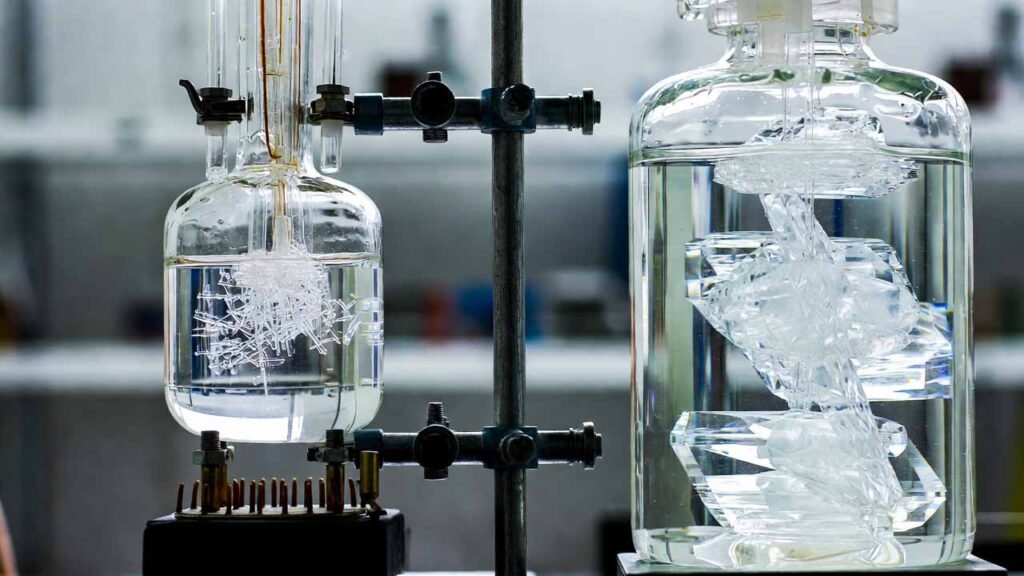
Deep-UV Nonlinear Optical Crystal Growth: Rb2B3O3F4(OH) for Frequency Doubling & OPO Modules
1) Overview and Technical Value
Rb2B3O3F4(OH) is a rubidium borate-fluoride-hydroxyl compound that can be grown into a stable nonlinear optical (NLO) single crystal for ultraviolet frequency conversion. The crystal belongs to an orthorhombic system (space group Ama2) and exhibits a deep-UV cutoff edge below 200 nm, making it attractive for short-wavelength UV generation in all-solid-state laser platforms.
In practical photonics, UV NLO crystals enable wavelength conversion from near-infrared or visible lasers into UV via second-harmonic generation (SHG), sum-frequency generation (SFG), and optical parametric processes. Compared with many conventional UV crystals where large-size growth can be challenging, the hydrothermal and room-temperature solution routes described here emphasize controllable supersaturation and defect suppression, supporting millimeter-scale transparent crystals suitable for device prototyping (e.g., SHG modules, up-/down-converters, and optical parametric oscillators).
2) Detailed Experimental Procedure
- Rb sources: RbHF2, Rb2CO3, RbHCO3, or RbF
- B sources: H3BO3 (boric acid) or HBO2 (metaboric acid)
- F sources: RbHF2, HF, or RbF
- Solvent: water (deionized recommended for reproducibility)
Target stoichiometry (molar): Rb : B : F = 2 : 3 : 4
- PTFE (Teflon) beakers and PTFE-lined autoclaves (or corrosion-resistant liners)
- Temperature-controlled oven/incubator for autoclaves
- Ultrasonic bath (for solution route)
- Qualitative filter paper
- Drying oven or muffle furnace (as required for drying steps)
Container hygiene matters for optical quality: acid-clean compatible vessels, rinse thoroughly with deionized water, and air-dry before use to minimize heterogeneous nucleation and inclusion formation.
A) Hydrothermal method (compound synthesis and/or single-crystal growth)
This route uses sealed PTFE-lined autoclaves to control dissolution–recrystallization under moderate temperature and pressure, supporting high transparency and reduced defect density.
| Step | Procedure | Key control points |
|---|---|---|
| 1. Charge & mix | In a 100 mL PTFE beaker, combine the selected Rb source, B source, and F source to match Rb:B:F = 2:3:4. Add 20–65 mL water and stir until a uniform mixed solution is obtained. | Keep composition consistent across batches. Adjust water volume within range to tune supersaturation and growth rate. |
| 2. Transfer & seal | Transfer the mixed solution into a 100 mL PTFE-lined high-pressure autoclave. Tighten and seal. | Use corrosion-resistant wetted parts. Ensure reliable sealing to maintain hydrothermal conditions. |
| 3. Heat program | Place the autoclave in a constant-temperature chamber. Heat at 10–30 °C/h to 150–220 °C. Hold for 2–5 days. | Temperature and hold time strongly influence nucleation density and final crystal size. |
| 4. Controlled cooling | Cool down to room temperature at 1–3 °C/h. | Slow cooling supports larger, clearer crystals with fewer thermal-stress defects. |
| 5. Harvest | Open the autoclave. From the colorless, clear solution, collect millimeter-scale Rb2B3O3F4(OH) crystals. Rinse quickly with deionized water and air-dry at room temperature. | Minimize mechanical shock. Avoid prolonged exposure to contaminated rinse water to preserve surface quality. |
B) Room-temperature solution method (evaporation-controlled crystallization)
This route emphasizes low thermal budget and simple equipment, using filtration and controlled solvent evaporation to drive slow crystallization.
| Step | Procedure | Key control points |
|---|---|---|
| 1. Prepare precursor solution | In a 100–300 mL PTFE beaker, combine selected Rb, B, and F sources to match Rb:B:F = 2:3:4. Add 40–100 mL water and stir until uniform. | Choose Rb feedstocks (e.g., Rb2CO3, RbF, RbHF2) to tune pH and fluoride activity for stable supersaturation. |
| 2. Ultrasonication | Sonicate the mixture to improve dissolution and homogeneity. | Better homogeneity reduces random nucleation and supports fewer, larger crystals. |
| 3. Filtration | Filter through qualitative filter paper to obtain a clear solution. | Particle removal is critical for optical-grade clarity (reduces inclusions and scattering centers). |
| 4. Seal & evaporation control | Seal with PVC film. Place in a static environment with no vibration, contamination, or air convection. Puncture several small pinholes to regulate evaporation rate. | Evaporation rate is the main “growth knob”: slower evaporation typically yields larger, clearer crystals. |
| 5. Growth & collection | Leave at room temperature until crystals gradually precipitate and growth completes. Collect millimeter-scale crystals and dry at room temperature. | Avoid handling during growth. Harvest gently to prevent chipping and microcracks. |
3) Comparison vs Traditional Production Routes
Traditional UV NLO crystal manufacturing often relies on high-temperature melt/flux growth (or related thermal-gradient techniques). For many borate and fluoride-containing systems, these routes can face one or more bottlenecks: high melt viscosity, component volatilization (especially fluorine-bearing species), parasitic phases, thermal stress cracking during cool-down, and limited scalability to large, inclusion-free crystals.
| Aspect | Conventional high-temperature growth (melt/flux, thermal-gradient) | Hydrothermal / room-temperature solution growth (this workflow) |
|---|---|---|
| Temperature | High; thermal stress and volatilization risks increase | Moderate (150–220 °C hydrothermal) or ambient (solution), lowering thermal stress |
| Chemistry control | Harder to stabilize fluoride/hydroxyl content under high heat | Ion activity (Rb+, F-, borate species) tunable via feedstock selection and solvent volume |
| Crystal quality | Risk of inclusions/defects from rapid nucleation and thermal gradients | Slow cooling or slow evaporation supports transparent crystals with fewer inclusions |
| Scale-up path | Requires complex furnaces/crucibles; yield sensitive to thermal profile | Scale by larger PTFE-lined reactors and longer growth cycles; simpler equipment footprint |
| Cost structure | Higher energy and refractory/corrosion component costs | Lower thermal energy; cost shifted toward high-purity salts and corrosion-resistant wet parts |
4) Why Rubidium Carbonate (Rb2CO3), Rubidium Fluoride (RbF), and Rb-Containing Compounds Matter
In Rb2B3O3F4(OH) synthesis and crystal growth, the rubidium source is not a passive reagent—it actively governs ionic strength, solubility, and the formation kinetics of the borate–fluoride framework. Selecting Rb2CO3, RbF, or hybrid salts such as RbHF2 provides practical control over Rb+ availability, fluoride activity, and solution chemistry, which directly impacts nucleation density and final optical quality.
- Rb2CO3 (Rubidium Carbonate): A robust, weighable rubidium feedstock that enables stable Rb+ delivery and supports consistent stoichiometry. In fluoride-assisted routes, carbonate-based charging can help process engineers tune the solution environment while maintaining a clean rubidium input, improving batch-to-batch repeatability and enabling transparent crystals with controlled growth rates.
- RbF (Rubidium Fluoride): A direct dual-function feedstock supplying both Rb+ and F-. This is valuable for constructing the borate–fluoride lattice and for adjusting fluoride activity without introducing additional cations, supporting purer phase formation and more predictable supersaturation profiles.
- Other Rb salts (RbHF2, RbHCO3): These options allow additional tuning of dissolution behavior and fluoride speciation. For example, combining Rb and F in one salt (RbHF2) can simplify reagent sets and improve ionic balance during early-stage nucleation control.
- Purity leverage for optical performance: UV NLO crystals are sensitive to trace metal and alkali contamination that can increase absorption and scattering. Using high-purity Rb2CO3/RbF and controlled moisture handling helps reduce defect formation, supporting the deep-UV transmission target (cutoff < 200 nm) and stable device performance.