
Miniature CPT Rubidium Vapor Magnetometer for Navigation, UAVs, and Medical Imaging
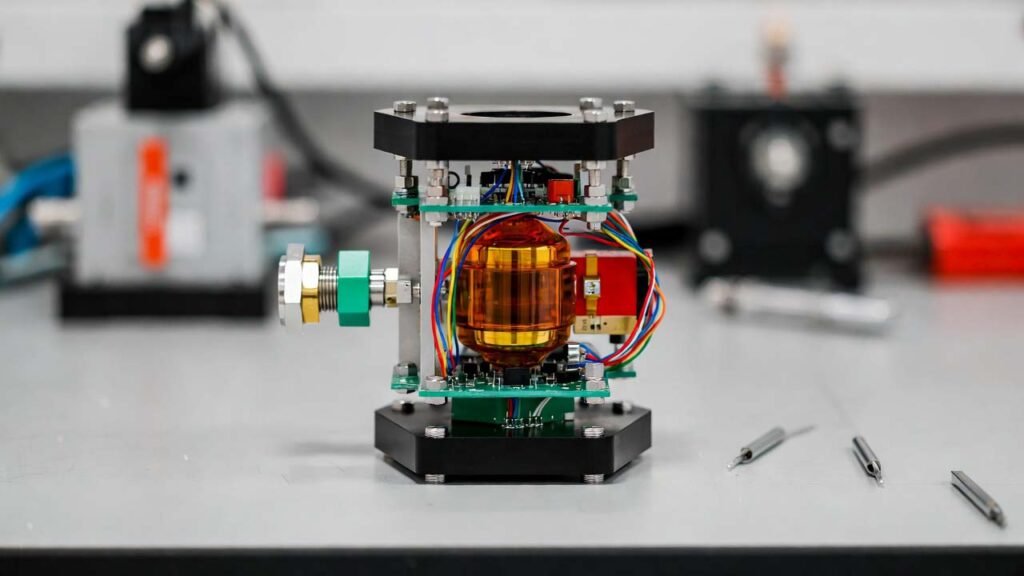
This device is a compact, opto-electronic coherent population trapping (CPT) magnetometer built around a sealed rubidium (Rb) atomic vapor cell. A dual-frequency coherent laser field is converted into circularly polarized light and sent through an Rb vapor interaction region; the transmitted (or reflected) optical power is detected by an integrated photodiode. When the two optical frequencies satisfy the CPT condition, the atomic population is driven into a “dark” superposition state and the optical response changes sharply. External magnetic fields shift the Zeeman sublevels and therefore move/split the CPT spectral features. By tracking these CPT resonance peak positions (e.g., three prominent peaks associated with Zeeman components under a defined optical geometry), the system calculates the magnetic-field magnitude with high sensitivity while keeping the overall package small, lightweight, and integration-friendly. This architecture targets applications that need precision magnetic sensing in tight volumes, such as attitude/navigation modules in autonomous systems, compact instrumentation in aircraft/satellites, and positioning/reconstruction support in medical magnetic imaging subsystems.
Hollow-Core Photonic Crystal Fiber Rubidium Vapor Blue Laser (420 nm) for Underwater Optical Communication & Precision Metrology
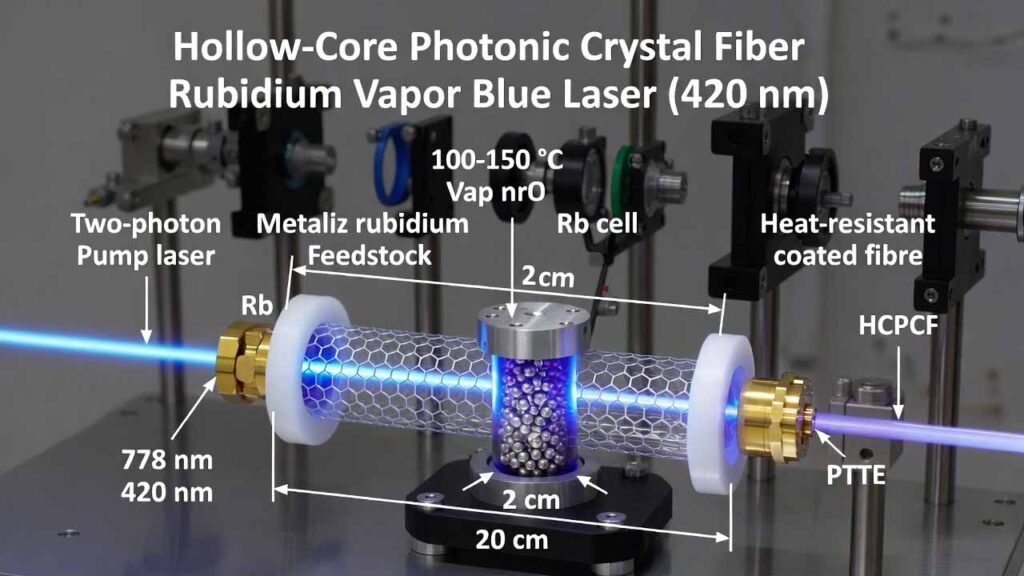
This configuration generates a narrow, directional 420 nm blue laser from rubidium (Rb) vapor by two-photon pumping at 778 nm inside a sealed vapor cell. A hollow-core photonic crystal fiber (HCPCF) is mounted inside the Rb cell and acts as an in-cell resonant/feedback and long-interaction structure: it extends the effective gain length and repeatedly guides the interacting wavelengths, helping the blue field build up into a stronger laser output.
Rubidium-Metal Doped Bipyridine Crystals for 2D Organic Antiferromagnets
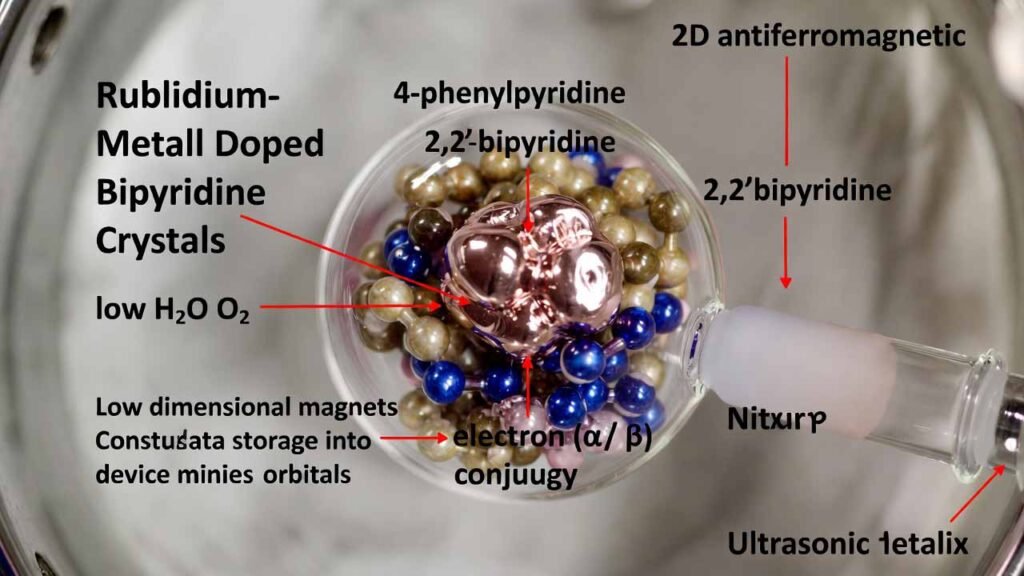
Low-dimensional magnets are attractive for next-generation information technologies because magnetic order can persist in extremely thin geometries, enabling dense data storage concepts, device miniaturization, and new quantum/spintronic functionalities. A major bottleneck is that many established low-dimensional magnets are inorganic and/or rely on complex fabrication routes (e.g., exfoliation, epitaxy), while purely organic low-dimensional magnets based on s/p-electron spins remain comparatively rare.
Cesium Fluoride (CsF) & Rubidium Fluoride (RbF) Supported Catalysts for Hexafluoropropene Dimerization (HFPD) in Fluorochemical Manufacturing
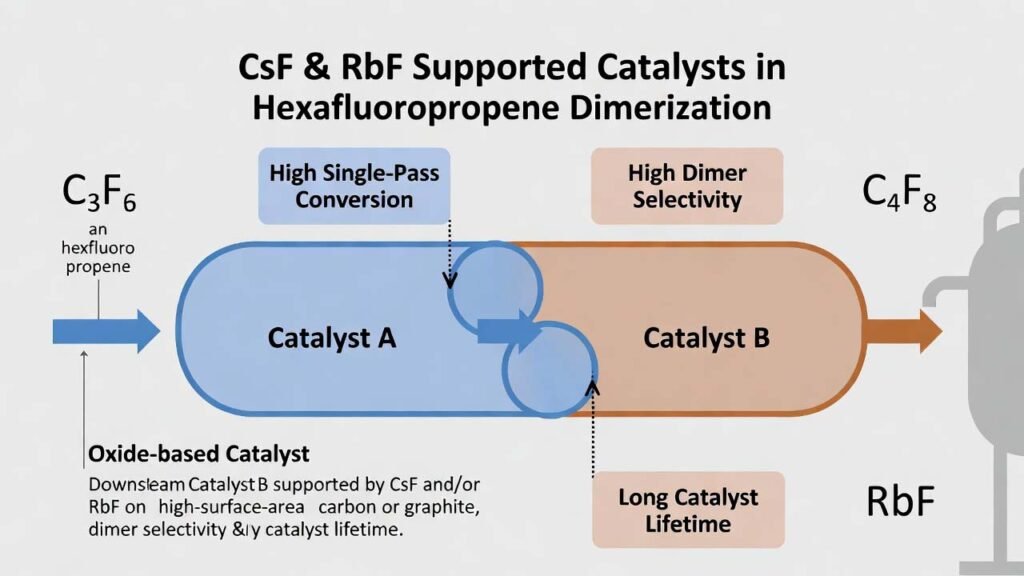
Hexafluoropropene dimer (HFPD) is a key fluorochemical intermediate because the remaining C=C bond enables downstream synthesis of multiple fluorinated derivatives used in pharmaceuticals, fluorosurfactants, specialty solvents, and replacement agents in fire protection chemistries. The practical challenge in HFP dimerization is achieving high single-pass conversion, high dimer selectivity (suppressing trimer formation), and long catalyst lifetime under controllable industrial conditions.
Rubidium Fluoride (RbF)–Activated Flux-Coated Zn–Al Brazing Rings for Copper–Aluminum Refrigeration Tubing
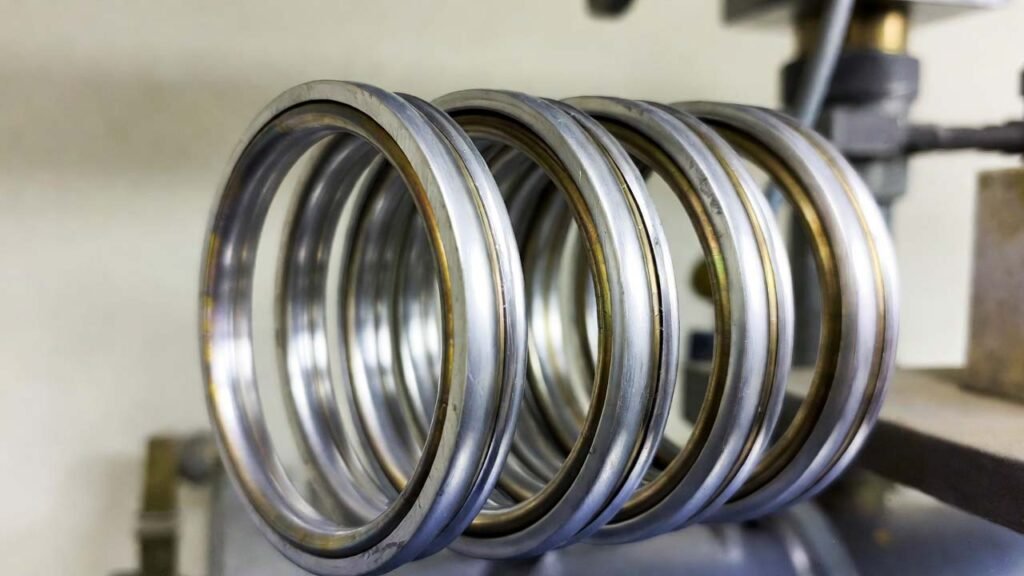
Flux-coated Zn–Al brazing rings are widely used for joining copper–aluminum tubing in refrigeration systems (e.g., compressors, condensers, and capillary lines), where stable wetting, high fillability, and consistent joint strength are required. This manufacturing approach builds a three-layer ring: an inner pure Zn tube that defines a small inner diameter, a Zn–Al alloy core layer (target alloy: Zn80Al20) formed by controlled alloying, and an outer flux coating that uses an RbF-based fluoride flux blended with AlF3. By using the pure Zn tube as a structural “support,” the ring can carry higher Al content (overall parts-by-mass typically Zn 75–85, Al 10–15, flux 3–10) without the severe brittleness that normally limits Zn–Al filler processing. In practical brazing validation, this structure is associated with improved leak resistance, higher fill rate, and higher joint tensile strength versus conventional flux-cored ring products.
Rubidium Fluoride (RbF)–Assisted Lead-Free Sn-Ag-Cu-Bi-Sb-Ni Solder Alloy Preparation for Electronics Joining
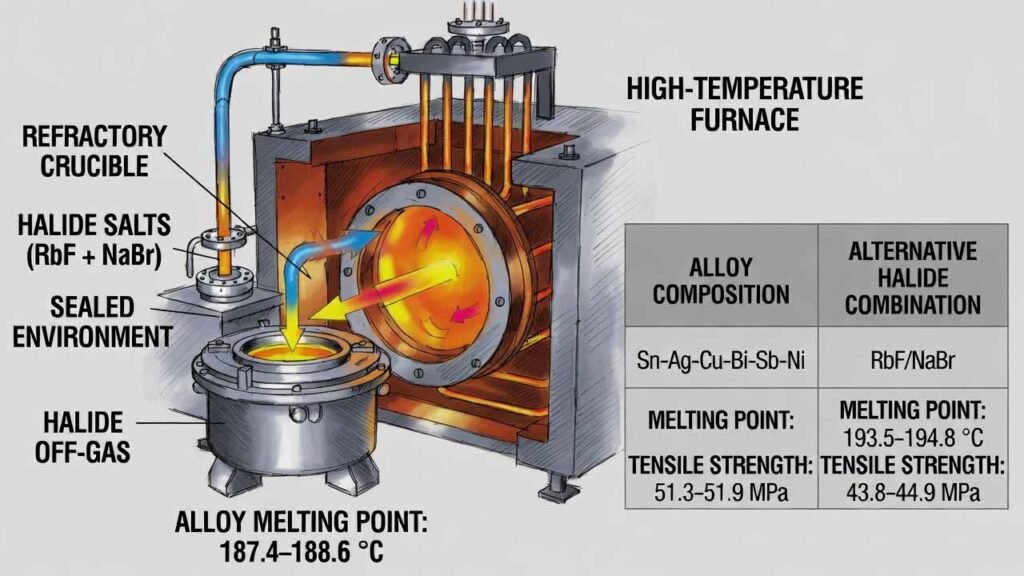
This workflow produces a lead-free tin-based multi-element solder alloy (Sn-Ag-Cu-Bi-Sb-Ni) designed for stable melting behavior and improved joint reliability. The core technical lever is introducing rubidium fluoride (RbF) together with sodium bromide (NaBr) during a sealed, high-temperature melt. Under sealed conditions, the halide additives generate a reactive halide-rich atmosphere that improves element compatibility during alloying, helping deliver a lower and more consistent melting point and higher tensile strength compared with non-matching halide systems.
CsF/RbF-Activated Low-Temperature Aluminum Brazing Flux for Al–Steel, Al–Cu, and Al–Al Joining
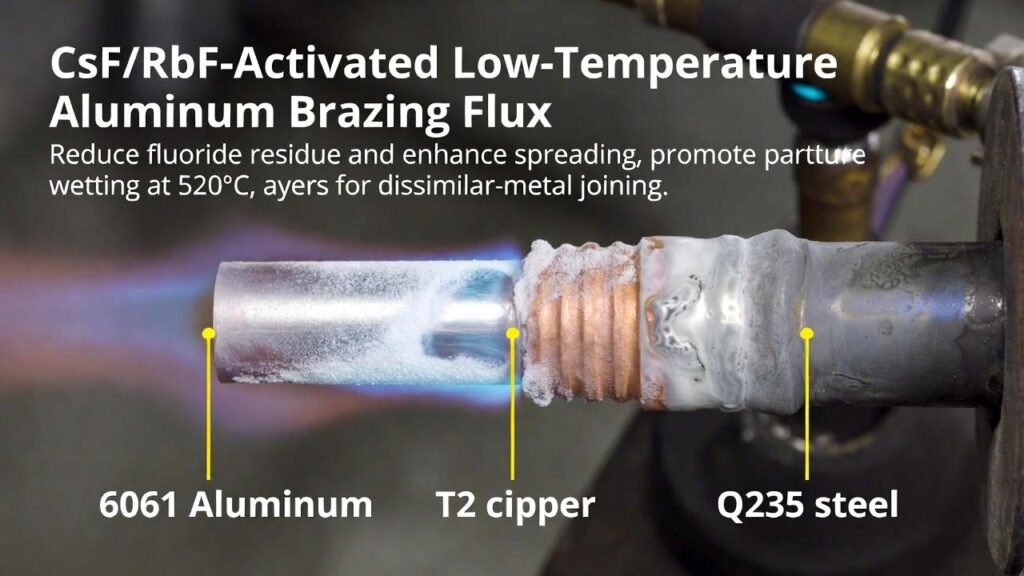
Aluminum and aluminum-alloy brazing in ambient atmospheres is fundamentally limited by the rapid formation of stable surface oxides. A high-activity fluoride-based flux is therefore essential to disrupt oxides, promote wetting, and enable reliable joints. Compared with conventional Nocolok-type fluxes (K3AlF6–KAlF4 / KAlF4) that typically operate near ~560–580 °C and often depend on controlled atmospheres, a CsF–AlF3 chemistry can lower the working temperature due to its reduced melting range. The flux system below further boosts wetting/spreading and supports dissimilar-metal brazing (“Al–steel”, “Al–Cu”) as well as “Al–Al” joints while keeping the melting range close to the filler melting window.
CsF & RbF Electron-Selective Passivated Contacts for Crystalline Silicon Solar Cells (c-Si PV)
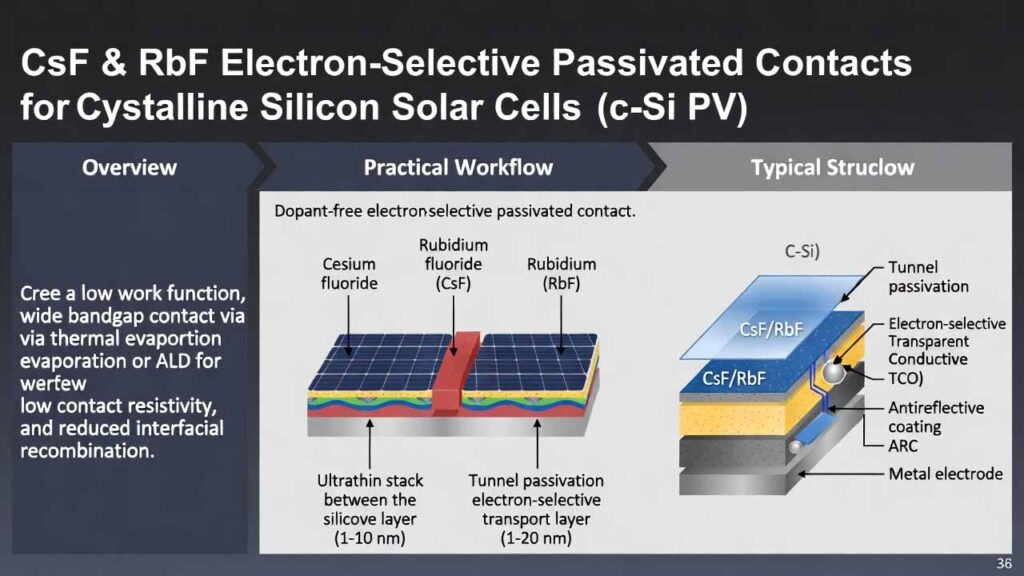
Crystalline silicon (c-Si) remains the most mature and widely deployed photovoltaic platform. The next efficiency gains increasingly depend on reducing carrier recombination and contact resistance at the c-Si/metal interface, while simplifying process complexity and lowering cost. Conventional architectures (e.g., direct metal contacts on lightly doped silicon in standard PERC) can suffer from interface defects, Fermi-level pinning, sizable Schottky barriers, and high recombination at the contact region.
Deep-UV Nonlinear Optical Crystal Growth: Rb2B3O3F4(OH) for Frequency Doubling & OPO Modules

Rb2B3O3F4(OH) is a rubidium borate-fluoride-hydroxyl compound that can be grown into a stable nonlinear optical (NLO) single crystal for ultraviolet frequency conversion. The crystal belongs to an orthorhombic system (space group Ama2) and exhibits a deep-UV cutoff edge below 200 nm, making it attractive for short-wavelength UV generation in all-solid-state laser platforms.
Rubidium Iodide (RbI) Electron-Injection Layer Design for High-Efficiency Organic Light-Emitting Devices (OLEDs)
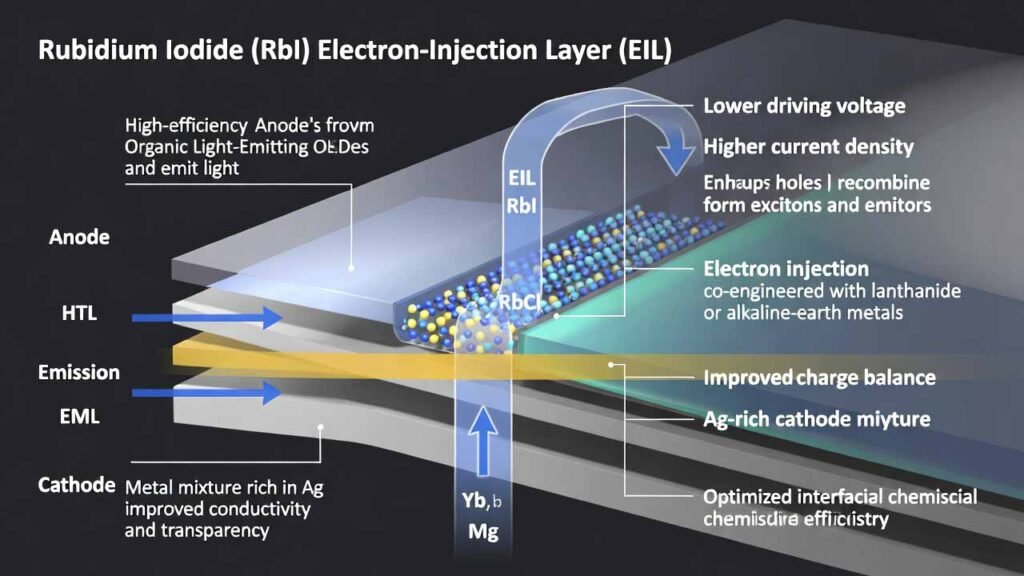
Organic light-emitting devices (OLEDs) are self-emissive stacks where holes (from the anode) and electrons (from the cathode) recombine in the emission layer (EML) to generate excitons and light. Beyond the EML, functional interlayers—hole injection/transport, electron transport, and especially the electron injection layer (EIL)—are decisive for lowering driving voltage, improving charge balance, and boosting luminous efficiency.