
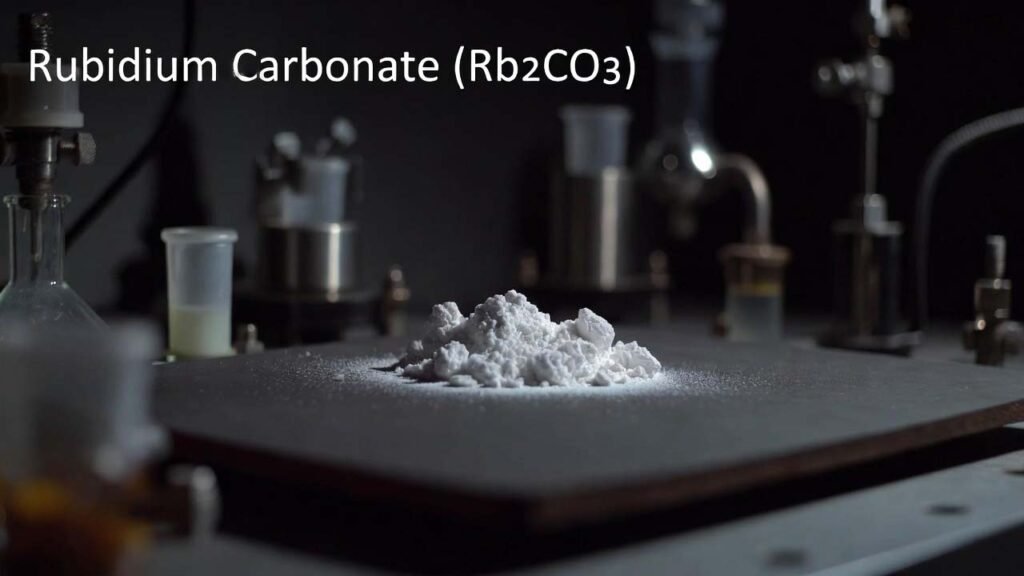
Rubidium Carbonate (Rb₂CO₃) in Catalysis & Materials Science: A Promoter for Microwave-Assisted Carbon-Supported Single-Atom Materials
Application focus: microwave-assisted synthesis of carbon-supported single-atom catalysts/materials (SACs) from organic/metal-organic precursors using ZnCl₂ as a microwave absorber and Rb₂CO₃ as a promoter.
1) Overview
Carbon-supported single-atom materials are widely studied in catalysis and optoelectronic-related materials research due to their high atom utilization, strong stability, and abundant anchoring sites on carbon. A key bottleneck in fast microwave routes is that many organic precursors (including some MOFs/COFs and metal–organic complexes) absorb microwaves poorly, which can lead to incomplete pyrolysis and low carbonization.
A practical solution is to combine ZnCl₂ (as a microwave absorber) with a promoter to amplify microwave heating and raise the effective pyrolysis temperature rapidly. In this workflow, Rubidium Carbonate (Rb₂CO₃) can be selected as the promoter to enhance the heating efficiency of the ZnCl₂-assisted system, enabling short, air-atmosphere microwave treatment to produce highly carbonized carbon-supported single-atom materials, followed by simple washing to remove residual salts.
Result expectation: without a promoter, microwave pyrolysis can be insufficient and carbonization may remain low; with a promoter such as Rb₂CO₃, the precursor can pyrolyze more completely, improving carbonization/graphitization indicators and helping form well-defined carbon frameworks for single-atom anchoring.
2) Detailed Experimental Procedure (Microwave-Assisted Route)
Recommended formulation window (mass ratios)
| Component pairing | Suggested mass ratio range | What it controls in practice |
|---|---|---|
| Organic precursor : ZnCl₂ | 1 : (1.5–8) | Microwave energy capture + molten-salt assisted carbonization intensity |
| Organic precursor : Rb₂CO₃ (promoter) | 1 : (0.2–8) | Heating amplification; improves completeness of pyrolysis under microwave |
| ZnCl₂ : Rb₂CO₃ | 1 : (0.2–1.2) | Balance between microwave absorption enhancement and removability after reaction |
A practical starting point for screening is often near precursor:ZnCl₂ ≈ 1:2, precursor:Rb₂CO₃ ≈ 1:0.5, ZnCl₂:Rb₂CO₃ ≈ 1:0.5, then tune for your precursor and target porosity/conductivity.
Step-by-step workflow
-
Select the organic precursor (metal-containing preferred).
- Options include MOFs, COFs, metal–organic complexes, metal–organic coordination polymers, ionic polymers, or other metal-containing organic precursors.
- Example families: Ni-ZIF type precursors, Ni-MET type precursors, metal phthalocyanines, metal porphyrins, acetylacetonate complexes (Fe/Co/Ni/Cu), etc.
-
Decide whether to add an auxiliary nitrogen source and/or carbon source (optional).
- N sources: melamine, dicyandiamide, urea, NH₄F, NH₄Cl, NH₄Br, NH₄HCO₃ (one or more).
- C sources: ascorbic acid, sucrose, cyclodextrin, glucose, carotene, starch, PVP (one or more).
- Typical ranges: precursor:N source = 1:(2–10); precursor:C source = 1:(2–30).
-
Weigh reagents and dry-mix thoroughly.
- Combine the organic precursor, ZnCl₂ (microwave absorber), and Rb₂CO₃ (promoter).
- Use an agate mortar (or equivalent) to grind until the mixture becomes homogeneous.
-
Load for microwave heating (air atmosphere).
- Place the mixed powder into an open container or microwave tube suited for solids.
- Keep the sample stable and upright (a simple conical flask holder setup is commonly used).
- Because this is rapid high-power heating, use microwave-compatible labware and shielding practices appropriate for corrosive salts.
-
Microwave pyrolysis.
Parameter Working window Typical screening point Power 400–3000 W ~800 W Band 300–6000 MHz Common lab microwave bands; tune to equipment Time 1.5–10 min ~3 min Atmosphere Air Air Rb₂CO₃ is used here to strengthen the ZnCl₂-assisted microwave heating so the organic precursor can undergo more complete thermal decomposition and carbonization within minutes.
-
Cool, recover, and (optionally) re-grind.
- Allow the solid to cool to a safe handling temperature.
- Grind gently to break up agglomerates and expose trapped salts for efficient removal.
-
Ultrasonic washing to remove Zn residues and the promoter.
- Use one or more of: water, HCl solution, HNO₃ solution, H₂SO₄ solution (or combinations).
- pH window: 1–7; ultrasonication time: 0.5–5 min per wash; number of washes: 1–5.
- After each wash: centrifuge/decant, then repeat as needed until conductivity/ion tests stabilize.
-
Drying.
- Dry the cleaned solid (typical lab range 60–100 °C). Common practice is ~90 °C for ~12 h, adjusted for batch size and vacuum capability.
-
Verify single-atom anchoring and carbon structure (recommended characterization).
- XRD: confirm absence of bulk metal crystalline peaks.
- Raman: D/G features to gauge carbonization/graphitization changes with promoter loading.
- N₂ adsorption: BET surface area and pore size distribution.
- XAS/EXAFS (or equivalent): validate M–N coordination and absence of M–M bonding for single-atom signatures.
Practical example template (adaptable)
If your baseline recipe previously used an alkali promoter like KCl, you can substitute Rb₂CO₃ by keeping the same promoter-to-ZnCl₂ and promoter-to-precursor ratios, then optimizing wash chemistry and microwave time for your specific precursor.
- Mix: precursor + ZnCl₂ + Rb₂CO₃ (within the ratio windows above).
- Microwave: ~800 W for ~3 minutes (screening start), in air.
- Wash: 1 M acid wash (e.g., HCl) with ~1 minute ultrasonication, repeat 2× as needed.
- Dry: ~90 °C until constant mass.
3) Comparison Summary: This Microwave Route vs Traditional Thermal Pyrolysis
| Dimension | Microwave + ZnCl₂ + Rb₂CO₃ promoter | Conventional furnace pyrolysis |
|---|---|---|
| Heating time | Minutes (1.5–10 min typical) | Often hours (heat-up + soak + cool-down) |
| Energy efficiency | Rapid, targeted microwave heating; reduced time-at-temperature | Long thermal cycles; higher total energy consumption |
| Precursor flexibility | Enables many poor microwave-absorbing organic precursors via absorber + promoter synergy | Broader by default, but slow and equipment-intensive |
| Process simplicity | Physical mixing → microwave → wash → dry | Controlled atmosphere often needed; longer ramps and dwell steps |
| Post-treatment | Salt removal by washing; Zn species and promoter designed to be removable | May require extended acid leaching; risk of metal nanoparticle growth during long heating |
| Scale-up logic | Short cycle time supports throughput scaling; mixing/washing are scalable unit ops | Scale-up constrained by furnace volume, uniform heat transfer, and long batch cycles |
In short, the ZnCl₂ + promoter strategy is designed to overcome insufficient microwave absorption of organic precursors. This directly addresses incomplete pyrolysis under microwave-only conditions and supports faster production of highly carbonized carbon frameworks suitable for stabilizing single atoms.
4) Why Rubidium Carbonate (Rb₂CO₃) Is Advantageous as the Promoter in This Application
- Boosts effective microwave heating with ZnCl₂: Rb₂CO₃ acts as a promoter to strengthen the microwave-heating performance of the ZnCl₂-assisted system, helping the precursor reach higher effective pyrolysis intensity within a short time window.
- Improves completeness of pyrolysis for poor microwave-absorbing organics: This is critical when your precursor is not inherently microwave-active; improved heating translates to higher carbonization and better-developed carbon structures.
- Supports higher carbonization/graphitization indicators: Increased carbonization typically improves electrical conductivity and structural robustness of the carbon host, which is beneficial for catalytic electron transport and stability.
- Easy removability after heating: A core practical requirement is that the promoter should be readily washed out after microwave treatment. Rb₂CO₃ fits this “post-process removable salt” role, aligning with fast purification workflows.
- Process-friendly and scalable: As a solid inorganic additive, Rb₂CO₃ integrates cleanly into dry-mixing and can be implemented with standard washing/centrifugation steps—unit operations that scale well.
- R&D tuning lever: By adjusting the precursor:Rb₂CO₃ and ZnCl₂:Rb₂CO₃ ratios within the defined windows, teams can tune heating strength, carbonization degree, and (often) textural properties without changing the core precursor chemistry.
Selection note for engineers: promoters in this family include alkali chlorides/oxides/carbonates. If your project is sensitive to halide carryover, carbonate promoters like Rb₂CO₃ are often considered during screening because they still provide heating promotion while keeping your “additive identity” in the carbonate class for downstream control strategies.
Keyword coverage for technical search: Rubidium Carbonate (Rb₂CO₃), microwave-assisted pyrolysis, ZnCl₂ microwave absorber, promoter-enhanced microwave heating, carbon-supported single-atom catalysts (SACs), MOF/COF-derived carbon, M–N–C single-atom materials. The synthesis method mentioned in this article references patent document number CN202310297995.1