
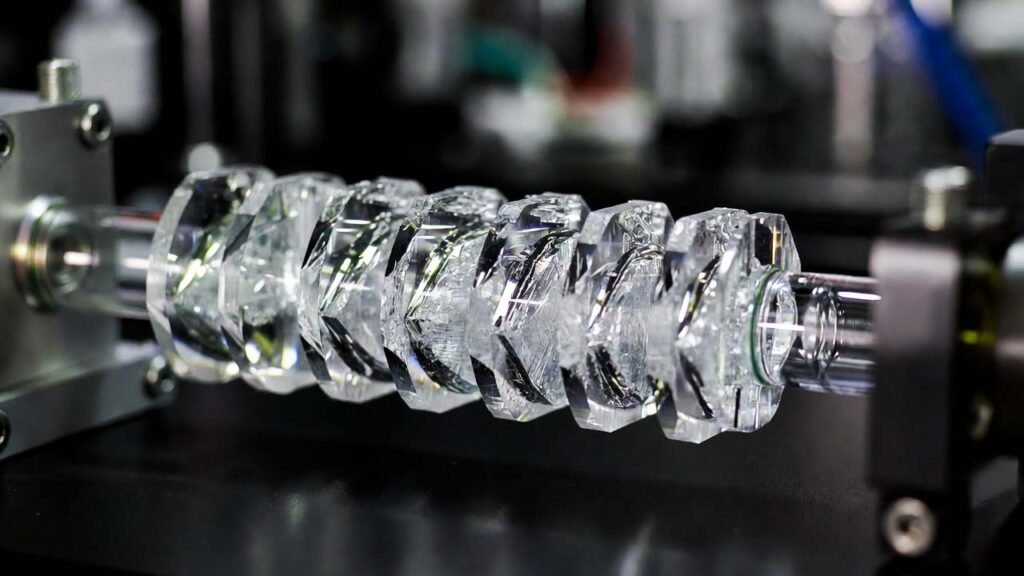
Rubidium Chloride in Photoluminescent Rhenium–Sulfide Cluster Crystals for LED Materials
1) Overview
Rhenium–sulfide cluster halide crystals based on Re6S8 units are a promising class of optoelectronic functional materials for photoluminescence (PL) and LED emitter development. Two composition families are commonly targeted: a cubic series (Rb1−xCsx)6Re6S8I8 and a trigonal series (Rb1−xCsx)5Re6S8Cl7, where 0 ≤ x ≤ 1 controls the Rb/Cs ratio.
For the chloride-based trigonal series, rubidium chloride (RbCl) is a primary feedstock that supplies Rb+ for A-site population and Cl− for halide stoichiometry. By combining RbCl with CsCl, rhenium metal, sulfur, and ReCl5 inside a sealed quartz ampoule under high vacuum/inert conditions, millimeter-scale single crystals with high phase purity and strong PL performance can be obtained. Reported PL quantum yields for representative compositions reach high levels (for example, Rb-based and Cs-based end members).
2) Detailed Experimental Process
A. Composition Design (choose x)
- Target phase: (Rb1−xCsx)5Re6S8Cl7 (trigonal, space group R3c).
- Set x between 0 and 1 to tune Rb/Cs occupancy and lattice parameters.
B. Raw Materials (chloride series)
- Rubidium chloride (RbCl) and cesium chloride (CsCl)
- Rhenium metal (Re)
- Elemental sulfur (S)
- Rhenium pentachloride (ReCl5)
- High-purity argon (glovebox/inert handling)
- Necked quartz ampoule + quartz plug/rod (baffle at the constriction)
- Vacuum line capable of reaching ~10−5 Pa, oxy-gas torch for sealing
- Programmable tube/box furnace with controlled ramp and slow-cooling capability
Key Stoichiometry
| Target | Feedstock molar ratio |
|---|---|
| (Rb1−xCsx)5Re6S8Cl7 |
RbCl : CsCl : Re : S : ReCl5 (50 − 50x) : (50x) : 11 : 20 : 4 |
Rb5Re6S8Cl7: a=b=9.5653 Å, c=52.0261 Å, α=β=90°, γ=120°
Cs5Re6S8Cl7: a=b=9.7718 Å, c=53.6568 Å, α=β=90°, γ=120°
C. Step-by-Step Synthesis Workflow (sealed-ampoule, high-temperature growth)
-
Inert preparation
In an argon glovebox (or rigorously inert environment), dry and stage all starting powders. Keep ReCl5 strictly moisture-free during weighing and mixing. -
Weighing & molar-ratio control
Calculate masses according to the target x value using: (50 − 50x) : (50x) : 11 : 20 : 4 for RbCl : CsCl : Re : S : ReCl5. Precise RbCl/CsCl ratio is the main handle for composition tuning. -
Homogeneous mixing
Mix the powders thoroughly until the blend is uniform. For reproducibility, keep particle size distribution consistent and avoid localized ReCl5 agglomeration. -
Ampoule loading
Transfer the well-mixed powder to the bottom of a pre-necked quartz ampoule (constriction located around the upper two-thirds of the tube length). Place a quartz plug/rod above the powder and seat it at the constriction as a baffle to help keep reactants away from the seal zone. -
Evacuation and argon purge cycling
Connect the ampoule to the vacuum line and evacuate to ~10−5 Pa. Backfill with high-purity argon, then evacuate again to ~10−5 Pa. Repeat the pump–purge cycle multiple times to improve internal cleanliness and remove residual gases. -
Flame sealing
While maintaining vacuum/inert conditions, seal the ampoule at the constriction region using an oxy-gas torch to fuse the quartz and fully close the system. Confirm the seal integrity before thermal processing. -
Thermal program: ramp → dwell → slow cool
Stand the sealed ampoule vertically in a programmable furnace and run:- Ramp: room temperature → 800°C at 100°C/h
- Dwell: hold at 800°C for 20 hours
- Slow cooling: 800°C → 600°C at 1°C/h (crystal growth window)
- Final cool: at 600°C, stop active control and allow furnace cooling to room temperature
-
Recovery of single crystals
After cooling, open the ampoule safely (mechanical break-out with appropriate shielding). Collect millimeter-scale single crystals from the product bed. -
Quality verification for R&D
Recommended checks include single-crystal/powder XRD for phase purity, EDS/element mapping for stoichiometry, and PL/PLQY evaluation to link composition (x) with optical response.
3) Comparison vs Traditional Approaches (process and outcomes)
| Aspect | Sealed-Ampoule High-Temperature Growth (this workflow) | Common traditional routes (typical limitations) |
|---|---|---|
| Crystal quality | Slow cooling under controlled vacuum/inert conditions supports growth of phase-pure, high-crystallinity single crystals with reduced secondary phases. | Uncontrolled solid-state reactions or faster cooling often yield smaller grains, mixed phases, and less reproducible crystallinity. |
| Impurity control | High vacuum and repeated argon cycling reduce oxygen/moisture contamination; sealing isolates the reaction from ambient exposure. | Open or weakly protected systems are more sensitive to moisture/oxygen, especially when chloride reagents and metal chlorides are involved. |
| Workflow complexity | Straightforward sequence: mix → seal → heat → slow cool → harvest. Equipment requirements are moderate (vacuum line + furnace). | Multi-step solution syntheses may require additional purification, solvent handling, atmosphere control, and tighter process windows. |
| Material positioning for lighting | Re–S cluster crystals demonstrate strong PL behavior and are positioned as key candidates for PL and LED materials, including broad emission response. | Many organic–inorganic hybrid perovskite systems face practical constraints such as lower quantum yield in some systems, toxicity concerns in lead-containing compositions, and manufacturing complexity/cost in scale-up scenarios. |
| Scale-up logic | Batch ampoule growth is reproducible for R&D screening and can be parallelized; composition tuning is handled by RbCl/CsCl ratio control. | Routes that depend on narrow solvent/antisolvent windows can be harder to transfer across scales without performance drift. |
4) Why Rubidium Chloride (RbCl) Is a Strong Choice in This Application
-
Direct stoichiometric lever for (Rb1−xCsx) tuning
RbCl is the primary Rb+ source in the chloride series. Adjusting the RbCl:CsCl ratio is the cleanest way to set x and reproducibly tune lattice parameters and optical response during composition screening. -
Halide supply for building the Re–S cluster framework
In the targeted formula (Rb1−xCsx)5Re6S8Cl7, chloride is an essential anion. Using RbCl ensures that the Rb and Cl inputs are tightly coupled for more predictable phase formation. -
Optical-grade impurity control starts with RbCl quality
For photoluminescent single crystals, trace alkali contamination and insoluble residues can degrade phase purity and introduce non-radiative centers. High-purity RbCl with low Na/K and low insolubles supports cleaner crystallization and more consistent PL evaluation. -
Moisture management with chloride chemistry
ReCl5 and halide-containing systems are moisture-sensitive. Low-moisture RbCl reduces unwanted side reactions and helps stabilize the sealed-ampoule environment throughout high-temperature processing. -
Better mixing behavior for reproducible growth
Controlled particle size distribution of RbCl improves powder blending uniformity, reducing local stoichiometry gradients that can otherwise lead to secondary phases and uneven nucleation. -
Enables a practical R&D pathway from crystal growth to devices
Cluster-based crystals in this materials family are noted for compatibility with polar solvents (e.g., water, DMF) in related compositions, supporting exploration beyond bulk crystals toward solution-processed thin films and optoelectronic device prototyping.