
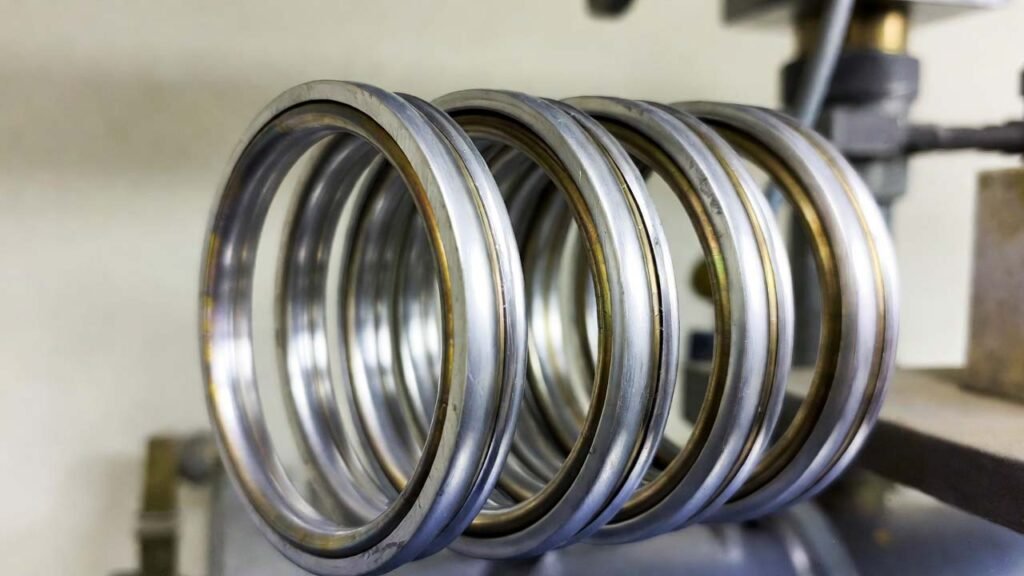
Rubidium Fluoride (RbF)–Activated Flux-Coated Zn–Al Brazing Rings for Copper–Aluminum Refrigeration Tubing
1) Overview and Technical Value
Flux-coated Zn–Al brazing rings are widely used for joining copper–aluminum tubing in refrigeration systems (e.g., compressors, condensers, and capillary lines), where stable wetting, high fillability, and consistent joint strength are required. This manufacturing approach builds a three-layer ring: an inner pure Zn tube that defines a small inner diameter, a Zn–Al alloy core layer (target alloy: Zn80Al20) formed by controlled alloying, and an outer flux coating that uses an RbF-based fluoride flux blended with AlF3. By using the pure Zn tube as a structural “support,” the ring can carry higher Al content (overall parts-by-mass typically Zn 75–85, Al 10–15, flux 3–10) without the severe brittleness that normally limits Zn–Al filler processing. In practical brazing validation, this structure is associated with improved leak resistance, higher fill rate, and higher joint tensile strength versus conventional flux-cored ring products.
2) Detailed Experimental / Production Procedure
The following procedure consolidates the full preparation workflow, including recommended compositions and key process windows. Parameters can be tuned within the stated ranges for different ring sizes and coating thickness targets.
-
Prepare the RbF–AlF3 high-temperature eutectic flux (core raw material emphasis: RbF).
- Weigh RbF and AlF3 to a mass ratio of 45–50 : 55–50; a proven reference ratio is RbF : AlF3 = 48.4 : 51.6.
- Homogenize the powder blend thoroughly.
- Heat to form a high-temperature eutectic at approximately 486 °C, then cool to solidify and crystallize.
- Crush/mill the solidified eutectic as needed to a particle size suitable for paste coating (fine, uniform powder improves coating continuity).
-
Form the binder system and flux paste.
- Prepare a binder mainly composed of ethanol and hydrogenated rosin alcohol at a mass ratio of 1–3 : 1 (reference: 2 : 1).
- Blend flux and binder to form a stable coating paste. Recommended binder : flux mass ratio is 5–10 : 1 (equivalently, flux : binder = 1 : 5 to 1 : 10).
- Mix until the paste is uniform (no dry pockets), with viscosity suitable for brushing/slot coating and for bath replenishment stability.
-
Prepare the pure Zn tube (inner layer) and machine retention threads.
- Select pure Zn tube size per target ring ID (examples demonstrated: ID 5–10 mm, wall thickness 0.8–2.0 mm).
- Surface pretreatment: lightly abrade with fine sandpaper and/or clean with alcohol; dry completely.
- Machine external threads on the Zn tube outer surface to mechanically lock the flux coating:
- Thread depth: 1/4 to 1/3 of the tube wall thickness.
- Thread pitch: 0.8–1.2 mm.
-
First coating: apply RbF-based flux paste to the Zn tube.
- Brush or coat a uniform layer of the flux paste onto the threaded Zn tube surface.
- Ensure complete coverage, especially in thread valleys, to prevent coating discontinuities after thermal steps.
-
Alloying pass: form the Zn–Al core layer (Zn80Al20) by controlled immersion/through-feed.
- Charge the first bath (liquid槽) with Zn–Al alloy melt of target composition Zn80Al20 and maintain it in a stable liquid phase using suitable heating (e.g., induction coil, electric furnace, heated platform, or salt bath system).
- Feed the pre-coated Zn tube through the Zn80Al20 melt bath at 15–20 mm/s (reference examples: 15, 16, 17, 18, 19, 20 mm/s).
- During this step, the outer region of the Zn tube reacts/alloys with the liquid Zn–Al to build the core layer while retaining the small-ID support of the inner Zn tube.
-
Second coating pass: build the external flux “skin” (outer layer).
- Pass the newly formed brazing tube through the second bath containing flux paste at 5–10 mm/s (reference examples: 5–10 mm/s).
- This step creates a continuous external flux coating with higher bonding strength, aided by the thread geometry and binder system.
-
Drying and finishing.
- Hot-air dry at 50–80 °C (reference examples: 50, 60, 70, 75, 80 °C) until the coating is non-tacky and mechanically stable.
- Cut/slice into rings at the required width; perform any standard edge finishing needed for feeding/placement in brazing assemblies.
-
Recommended composition targets (parts by mass for the finished ring).
- Typical window: Zn 75–85, Al 10–15, flux 3–10.
- Common tighter window: Zn 76–84, Al 12–14, flux 4–8.
-
QC / validation (engineering-oriented).
- Coating continuity inspection (visual + weight gain tracking per meter of tube).
- Ring integrity check after cutting (cracking/brittle fracture screening).
- Application tests for Cu–Al joints: leak test under pressure, metallographic fill-length ratio, and tensile testing of standardized joints.
| Key Parameter | Recommended Range | Purpose / Practical Note |
|---|---|---|
| RbF : AlF3 (flux) | 45–50 : 55–50 (ref. 48.4 : 51.6) | Forms a high-activity fluoride eutectic; ratio stability helps consistent melting/activation behavior. |
| Eutectic formation temperature | ~486 °C | Builds a uniform eutectic flux phase that is easier to formulate into a stable coating paste. |
| Thread depth | 1/4–1/3 wall thickness | Mechanical anchoring of flux skin; reduces coating delamination during thermal exposure. |
| Thread pitch | 0.8–1.2 mm | Balances paste retention and manufacturability across different tube sizes. |
| Through-feed speed (Zn80Al20 bath) | 15–20 mm/s | Controls alloying extent and core layer uniformity. |
| Through-feed speed (flux paste bath) | 5–10 mm/s | Controls coating thickness and continuity. |
| Hot-air drying temperature | 50–80 °C | Fast solvent removal while maintaining coating integrity. |
Note: Exact bath temperatures for maintaining the Zn80Al20 melt depend on furnace design and thermal losses; engineering control should ensure stable liquid-phase behavior and repeatable wetting/alloying during through-feed.
3) Comparison vs. Conventional Processing (Summary)
Conventional Zn–Al brazing rings are often produced by melting and casting the alloy, followed by extrusion, rolling, multi-pass wire drawing, winding, and cutting into rings. When Al content rises beyond typical low levels, plasticity degrades sharply, causing severe work hardening, wire breakage, cracking during ring forming, and low yield. Flux-cored ring formats also face a structural limitation: the internal flux can become discontinuous or the core can break internally, which is difficult to detect visually and leads to unstable brazing quality.
| Item | Flux-Coated Zn–Al Ring (RbF–AlF3 outer flux skin) | Conventional Flux-Cored / Drawn Wire Ring |
|---|---|---|
| Process steps | Tube prep → threaded retention → bath alloying → surface flux coating → drying → cutting | Melting → extrusion → rolling → multi-pass drawing → winding → cutting (many steps) |
| Yield & time (20 kg class example) | ~97.5% yield and ~4 h total processing | ~17.5% yield and ~10 h total processing |
| Flux continuity | Continuous external flux layer; easy visual inspection | Risk of internal flux discontinuity / broken core; difficult to detect |
| Brazing performance (Cu–Al joint example) | No leakage observed; fill rate ~92%; average tensile strength ~95 MPa | Leakage observed (~6%); fill rate ~78%; average tensile strength ~83.5 MPa |
4) Why Rubidium Fluoride (RbF) Delivers a Strong Advantage in This Application
RbF is the enabling raw material for the active fluoride flux system used to make a reliable “flux skin” on the brazing ring. In combination with AlF3, RbF forms a high-temperature eutectic flux (~486 °C) that can be processed into a stable paste and deposited as a continuous coating. From a brazing chemistry standpoint, RbF-based fluoride fluxes supply highly active fluoride species that help disrupt and dissolve tenacious oxide films on aluminum surfaces, which is essential for wetting, capillary flow, and high fillability in Cu–Al joints. Because the flux is placed on the surface (not hidden in a core), the RbF-driven activity is available exactly where oxide disruption and spreading must happen first, improving consistency and reducing defect sensitivity.
RbF also supports manufacturability: it enables an effective, continuous flux coating that avoids the “discontinuous flux / broken core” risk common to flux-cored formats, while remaining compatible with a practical binder system (ethanol + hydrogenated rosin alcohol) used to achieve high coating adhesion and fast drying. Finally, higher Al content in the ring improves filler strength and can improve flux–filler matching during melting; pairing that high-Al Zn–Al core with an RbF-activated eutectic flux is a direct route to more stable wetting, fewer pores/slag inclusions, and stronger joints in demanding refrigeration tubing assemblies.