
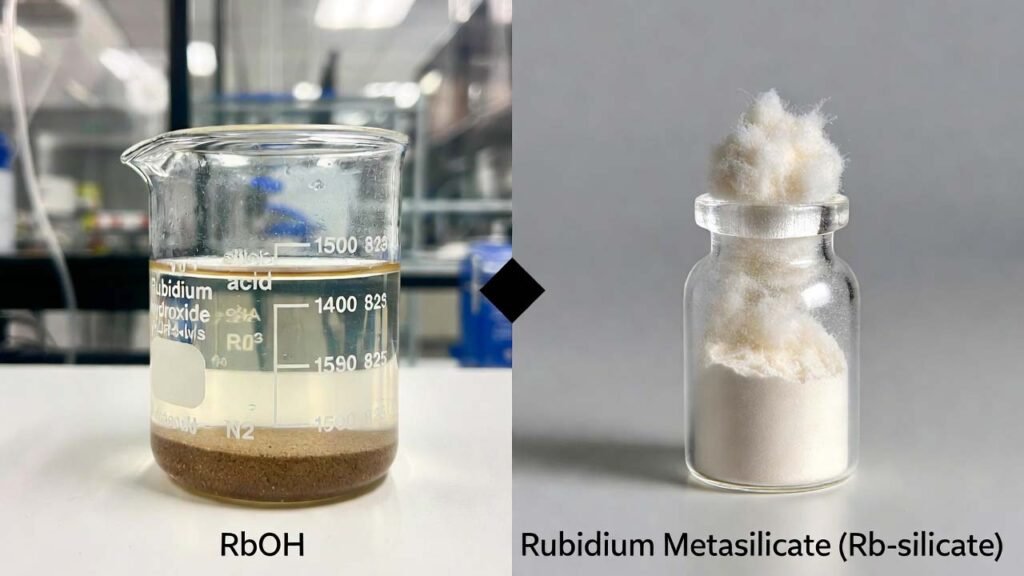
Rubidium Hydroxide in Rubidium Metasilicate for GC Nitrogen–Phosphorus Detector (NPD) Performance
1) Overview
Gas chromatography nitrogen–phosphorus detectors (NPDs) are widely used for trace analysis of nitrogen- and phosphorus-containing compounds in environmental monitoring, food safety, pharmaceutical analysis, clinical metabolism studies, and related applications. A key factor governing NPD sensitivity, selectivity, and operational lifetime is the performance of the detector’s sensitive material.
This workflow prepares rubidium metasilicate via an aqueous reaction using rubidium hydroxide (RbOH) as the rubidium source, followed by freeze-drying and inert-gas annealing to obtain a stable powder suitable for detector fabrication. The approach emphasizes process control (pH, clarity/transmittance, moisture, annealing atmosphere, and cooling rate) to improve product consistency and yield, and to support longer detector service life during GC operation.
2) Detailed Experimental Procedure
Materials & equipment
- Rubidium hydroxide (RbOH)
- Metasilicic acid (referred to as “metasilicic acid” in the provided process)
- Purified water (deionized recommended)
- Beaker sized to exceed the final solution volume by >10%
- Magnetic stirrer (or equivalent controlled-speed mixing)
- pH meter or high-range pH paper
- Transmittance measurement (spectrophotometer preferred) or clarity inspection
- Freeze dryer with vacuum pump
- Ceramic crucible
- Tubular furnace with nitrogen purge/control
- Moisture measurement (e.g., IR moisture analyzer or KF as applicable)
Safety: RbOH is strongly caustic. Use appropriate PPE and corrosion-resistant tools. High-temperature annealing must follow furnace and gas safety protocols.
Step S1 — Aqueous reaction and solution quality control
-
S1.1 Charge RbOH
Weigh rubidium hydroxide and add it to a clean beaker. -
S1.2 Dissolve RbOH completely
Add the predetermined amount of purified water and begin magnetic stirring.- Set stirring speed to 300 r/min for 10 minutes (extend if needed).
- Confirm complete dissolution by pH: when fully dissolved, the solution pH should be ≥ 13. If pH < 13, continue stirring and re-check.
- Record the final mixing time, then stop stirring and allow the solution to rest briefly (helps bubble release and stabilizes clarity).
-
S1.3 Add metasilicic acid slowly and dissolve
Slowly introduce metasilicic acid into the fully dissolved RbOH solution to avoid local concentration spikes and to keep the system uniform.- Set stirring speed to 500 r/min for 15 minutes (extend if needed).
- Measure solution transmittance: ≥ 80% is required. If < 80%, extend stirring until the target is met.
- After the solution becomes transparent and free of visible precipitate, continue stirring for an additional 3 minutes to consolidate uniformity.
-
S1.4 Final acceptance check
Accept the solution when it is transparent and free of visible particles.
Stoichiometry note
The specified molar ratio for RbOH : metasilicic acid = 2 : 1. This ratio is central to achieving the intended rubidium content and alkaline reaction environment.
Step S2 — Freeze-drying to obtain a low-moisture precursor powder
- S2.1 Pour the homogeneous solution into a suitably sized freeze-drying tray to ensure an even layer.
- S2.2 Freeze at -50°C for 24 hours.
- S2.3 Start vacuum drying: set vacuum to < 10 Pa and dry for 72 hours.
-
S2.4 Moisture QC
Measure moisture of the resulting white powder and confirm ≤ 5%. If moisture > 5%, extend drying time and re-test.
Step S3 — Nitrogen-protected annealing to obtain the final gray-white powder
- S3.0 Transfer the freeze-dried white powder into a clean ceramic crucible and level the powder bed for uniform heating.
-
S3.1 Inert preheat stage
Place the crucible into a tubular furnace preheated to 800°C. Start nitrogen protection at 5 mL/min. -
S3.2 High-temperature anneal
Raise temperature to 1000°C and hold for 4 hours. -
S3.3 Controlled cooling
Cool to room temperature with a cooling rate ≤ 10°C/min. If the rate exceeds 10°C/min, pause cooling until stabilized, then continue.
Output: gray-white powder (rubidium metasilicate product as described in the provided process).
Optional end-use workflow — Preparing an NPD coil coating for GC analysis
-
Coating slurry preparation
Dissolve a measured amount of the rubidium metasilicate product in purified water, then add silicate-based cement powder and mix uniformly to form a viscous slurry.Mass ratio (rubidium metasilicate : water : silicate cement) = 1 : 2 : 15. - Coating Apply the viscous slurry evenly onto the NPD detector coil.
- Drying Dry the coated coil in an oven until fully set.
- Installation & operation Install the dried detector into the GC for nitrogen/phosphorus detection.
Example GC–NPD parameter set (as provided)
| Parameter | Setting |
|---|---|
| Injector temperature | 220°C |
| Split ratio | 1:20 |
| Flow mode | Constant flow |
| Oven (column box) temperature | 150°C |
| Detector temperature | 300°C |
| Hydrogen flow | 3.8 mL/min |
| Air flow | 100 mL/min |
| Nitrogen flow | 20 mL/min |
| Current | 2.9 A |
| Standard sample | Azobenzene 2 ng/µL + Malathion (as provided) 4 ng/µL mixed |
| Injection volume | 1 µL |
3) Comparison Summary: This Route vs. Conventional Approaches
Conventional preparation of rubidium silicate-type sensitive materials is often described as a multi-stage sequence involving high-temperature fusion, alkaline processing, low-temperature crystallization, and repeated washing/purification. In practice, several recurring issues can reduce reproducibility and yield.
| Common challenge in traditional routes | How this workflow addresses it |
|---|---|
| Rubidium loss at high temperature due to rubidium salt volatility | Uses aqueous formation first, then applies N2-protected annealing to reduce unwanted reactions during thermal treatment. |
| Low recovery because rubidium silicate products can be highly soluble under strong alkaline conditions | Converts a controlled, clear solution into a solid via freeze-drying, limiting loss pathways associated with prolonged liquid-phase handling. |
| Non-uniform crystallization from rapid precipitation during cooling/crystallization | Emphasizes solution clarity/transmittance control before drying and then uses defined annealing + controlled cooling rate to stabilize structure. |
| Silicate precipitation triggered by unstable silicate species during pH adjustments | Maintains a strong alkaline environment (RbOH dissolution acceptance at pH ≥ 13) and requires transparent, particle-free solution before drying. |
| Difficulty removing residual impurities via repeated washing | Relies on vacuum freeze-drying (moisture ≤ 5%) and inert annealing to achieve a clean, stable powder without heavy wet purification cycles. |
4) Why Rubidium Hydroxide (RbOH) Is Superior in This Application
In this process, rubidium hydroxide is not just a rubidium source; it is the key process enabler that controls reaction environment, rubidium incorporation efficiency, and final material consistency for NPD use.
- High-reactivity rubidium supply: RbOH delivers rubidium in a highly available ionic form, supporting rapid and complete formation of the target rubidium silicate species in water.
- Built-in alkaline driving force: The strong basicity (acceptance at pH ≥ 13) promotes dissolution and homogeneous reaction, reducing incomplete conversion and minimizing particle formation before drying.
- Process controllability for engineers: Clear QC gates (pH threshold, transmittance ≥ 80%, moisture ≤ 5%, N2 flow, time/temperature, cooling rate) make scale-up and batch consistency more practical.
- Better downstream manufacturability: A clean, uniform precursor solution created with RbOH converts efficiently into a dry powder by freeze-drying, improving powder handling and reducing variability in coil-coating formulations.
- Detector performance leverage: A consistent rubidium metasilicate sensitive material supports stable coil coatings and contributes to high-sensitivity N/P detection conditions in GC–NPD workflows, while helping extend usable detector lifetime in operation.
The synthesis method mentioned in this article references patent document number CN202411806657.7