
Rubidium Nitrate-Enabled Microwave Hydrothermal Ion Exchange for Ultra-Thin Chemically Strengthened Display Cover Glass
1) Overview
Ultra-thin glass (typically ≤ 1.5 mm) is widely used as protective glass in electronic information displays such as smartphones and tablets, where drops and impacts can easily cause cracking. Chemical strengthening improves strength by creating a surface compressive stress layer through ion exchange: smaller surface Na+ ions in the glass are replaced by larger alkali ions, generating compressive stress at the surface.
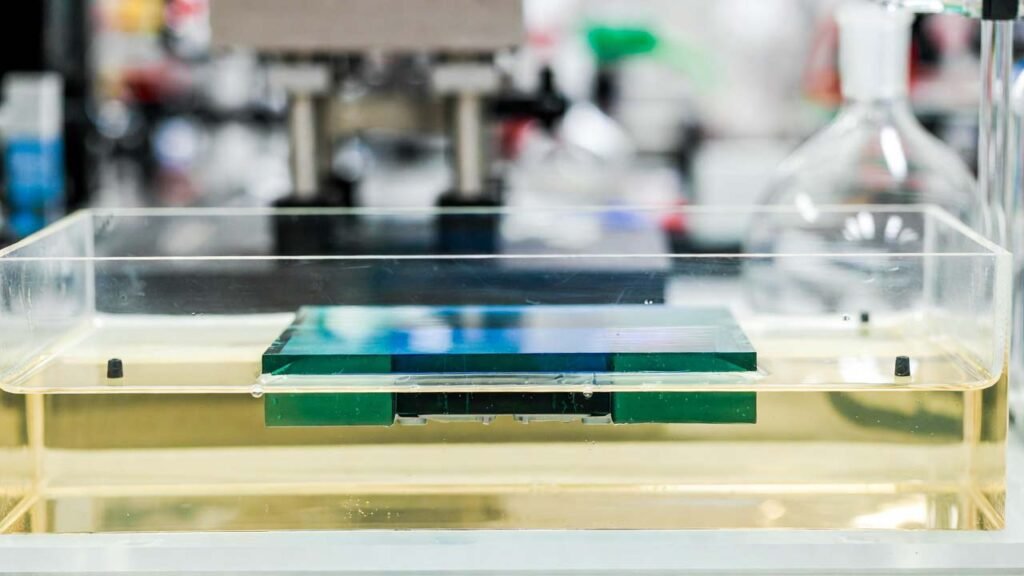
This process performs ion exchange by immersing the glass in an aqueous ion-exchange solution under a microwave hydrothermal environment. The solution is formulated from potassium nitrate, potassium silicate, rubidium nitrate, and cesium nitrate. Microwave hydrothermal conditions accelerate ion transport and diffusion, improving the exchange rate and reducing overall processing time while maintaining good optical transmission.
2) Detailed Experimental Process
Step A — Prepare the ion-exchange solution (aqueous)
- Use ultrapure water as the solvent.
- Dissolve the following reagents to obtain a clear ion-exchange solution:
- Potassium nitrate (source of K+)
- Potassium silicate (acts as a rate-promoting additive in the solution)
- Rubidium nitrate (source of Rb+)
- Cesium nitrate (source of Cs+)
| Parameter | Operating window | Recommended setpoint examples |
|---|---|---|
| K+ concentration | 27–40 mol/L | 30–36 mol/L commonly used |
| Rb+ concentration (from rubidium nitrate) | 0.5–4 mol/L | 2.5 mol/L or 3.0–3.5 mol/L used in typical strengthened samples |
| Cs+ concentration | 1.5–4.5 mol/L | 2.0–3.0 mol/L commonly used |
| Molar ratio: potassium nitrate : potassium silicate | 1 : 0.002–0.05 | 1 : 0.02 (preferred based on stress-depth behavior) |
Practical note: Increasing the potassium nitrate : potassium silicate ratio tends to increase surface compressive stress, while stress-layer depth can show a peak behavior (first increases, then decreases). A ratio around 1:0.02 is a strong practical choice when balancing stress magnitude and depth.
Step B — Prepare the ultra-thin glass substrate
- Use aluminosilicate glass with thickness ≤ 1.5 mm (test samples are often ~0.65–0.75 mm).
- Cut the glass to the required size and polish the surfaces/edges as needed.
- Clean the glass surface using acetone followed by ethanol, then dry thoroughly.
Step C — Microwave hydrothermal ion exchange
- Immerse the dried glass fully in the prepared ion-exchange solution.
- Place the container into a microwave hydrothermal instrument and perform ion exchange under the following conditions:
- Temperature: 300–350 °C
- Time: 4–10 hours
- After ion exchange, cool the system to room temperature.
| Recipe | K+ (mol/L) | Rb+ (mol/L) | Cs+ (mol/L) | KNO3 : potassium silicate | Temperature | Time |
|---|---|---|---|---|---|---|
| Example set 1 | 30 | 2.5 | 3.0 | 1 : 0.02 | 340 °C | 5 h |
| Example set 2 | 36 | 3.0 | 2.0 | 1 : 0.02 | 320 °C | 8 h |
| Example set 3 | 33 | 3.5 | 2.5 | 1 : 0.02 | 300 °C | 10 h |
| Example set 4 | 27 | 0.5 | 1.5 | 1 : 0.02 | 300 °C | 6 h |
| Example set 5 | 40 | 4.0 | 4.5 | 1 : 0.02 | 350 °C | 4 h |
Temperature control matters: processing outside an appropriate temperature range can reduce strengthening effectiveness. Excessively high temperature may not improve stress-layer depth and can reduce surface stress due to stress relaxation.
Step D — Post-treatment cleaning and drying
- Remove the glass after cooling.
- Rinse with pure water; ultrasonic cleaning in pure water can be used to remove residual salts.
- Dry to obtain ultra-thin chemically strengthened glass.
Performance checkpoints (typical outcomes)
- Surface compressive stress can exceed 700 MPa.
- Stress-layer depth can reach > 45 μm.
- Visible transmittance (380–780 nm) is typically ~92%–94%, supporting high transparency applications.
3) Comparison vs Traditional Ion-Exchange (Molten-Salt) Strengthening
| Aspect | Microwave Hydrothermal Aqueous Ion Exchange | Traditional Molten-Salt Ion Exchange |
|---|---|---|
| Ion-exchange medium | Water-based nitrate solution with potassium silicate + controlled Rb/Cs additions | Molten salts (large salt consumption) |
| Process speed | Accelerated by microwave hydrothermal conditions; typical strengthening in 4–10 h | Often longer due to diffusion-limited ion migration (commonly many hours) |
| Environmental impact | Lower pollution and reduced energy waste compared with molten-salt approaches | Higher risk of waste, contamination, and energy loss from bulk molten salts |
| Suitability for ultra-thin glass | Well-suited for ≤ 1.5 mm glass; chemical strengthening imposes minimal shape/thickness limitations | Process constraints can be more sensitive to handling and uniformity in thin substrates |
| Strengthening metrics | Deep stress layer and high surface stress achievable while maintaining high transmittance | Strengthening achievable, but efficiency and resource usage can be less favorable |
4) Why Rubidium Nitrate Matters in This Application
Rubidium nitrate is the engineered source of Rb+ in the ion-exchange bath. In this process, Rb+ and Cs+ do more than “add ions” to the solution: their controlled, low-to-moderate concentrations work alongside K+ to increase ion-exchange efficiency and deepen the compressive stress layer in ultra-thin glass.
- Rb+ and Cs+ can occupy positions initially held by Na+ near the surface, helping drive rapid substitution under hydrothermal conditions.
- Rb+ and Cs+ can further interact with K+ in the glass/solution interface, improving the overall exchange dynamics and stress-layer development.
- Using rubidium nitrate enables precise Rb+ dosing (0.5–4 mol/L), which is critical: “too little” limits the benefit, while “too much” can complicate optimization of stress and depth.
| Condition | Surface stress (MPa) | Stress-layer depth (μm) | Impact performance (cm) |
|---|---|---|---|
| K+-only aqueous exchange (representative comparator) | 632.1 | 37.3 | 73 |
| K+ + potassium silicate + Rb+ (from rubidium nitrate) + Cs+ (optimized window) | 710.5–758.0 | 45.5–52.4 | 96–127 |
From a manufacturing and scale-up perspective, rubidium nitrate is also practical: it is straightforward to handle as a high-purity ionic precursor in aqueous systems, allowing reproducible control of Rb+ concentration and consistent strengthening performance across batches—especially important for display cover glass where mechanical reliability and optical clarity must both be maintained. The synthesis method mentioned in this article references patent document number CN201810567543.X