
Rubidium Nitrate–Impregnated Activated Carbon Catalyst for Trifluoroiodomethane (CF3I) Fire Suppression Agent Synthesis
1) Overview
Trifluoroiodomethane (CF3I) is a fluoroiodocarbon valued in clean-agent fire suppression and as a low-ozone-impact alternative in certain halocarbon applications. A practical gas-phase route uses gaseous trifluoromethane (CF3H) and iodine (I2) over an activated-carbon-supported alkali salt catalyst at high temperature. The key operational challenge is catalyst deactivation from carbon deposition (coking) caused by reactive CF2 carbene intermediates that disproportionate and leave solid carbon.
This workflow integrates rubidium nitrate (RbNO3) as the active salt on activated carbon and uses dynamic oxygen dosing to continuously balance two competing needs: (i) oxidizing deposited carbon to keep pores open and active sites exposed, and (ii) preventing excessive oxidation (burn-off) of the activated carbon support.
- CF3H, I2, and O2 at high temperature present significant hazards (toxicity, oxidizer risk, corrosion, and high-temperature reaction control).
- Use appropriate materials of construction, iodine handling controls, inert-gas purging procedures, and robust off-gas scrubbing.
- Oxygen introduction can generate localized heat release during carbon oxidation; reactor temperature control and hotspot monitoring are essential.
2) Detailed Experimental Procedure
- Pre-dry the activated carbon support: Vacuum-dry at 110–130 °C for 2–3 h to remove moisture and improve impregnation uniformity.
- Prepare rubidium nitrate solution: Dissolve rubidium nitrate in deionized water to target an approximate 10 wt% loading on activated carbon (mass basis).
- Impregnation by dropwise addition: Add the RbNO3 solution to the dried activated carbon with controlled wetting (incipient-wetness style).
- Aging/standing: Allow the impregnated carbon to stand for about 24 h to promote distribution and interaction with surface functional groups.
- Post-impregnation drying: Vacuum-dry at 110–130 °C for 5–7 h.
-
Protected-atmosphere calcination:
Under inert gas (e.g., N2), heat-treat in two stages:
- 290–310 °C for 2–3 h
- Then raise to 540–560 °C and hold for 2–3 h
Mechanistic intent: RbNO3 treatment increases oxygen-containing surface groups on activated carbon, improves dispersion of active salt species, and can promote CF3H activation, supporting higher and more stable catalytic activity.
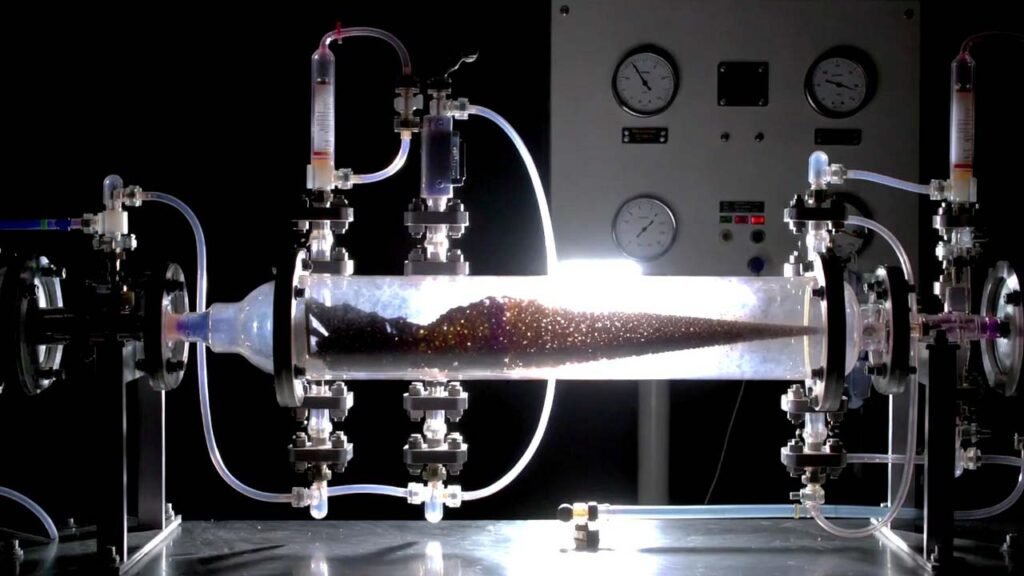
- Reactor type: Fixed-bed reactor loaded with the prepared RbNO3/AC catalyst.
- Operating temperature: Set within 500–600 °C based on selectivity and stability targets.
- Space velocity: Control within 220–310 h-1 to avoid under-conversion (too high) or productivity loss (too low).
- Feed initialization: Begin feeding gaseous CF3H, I2, and O2 at: CF3H : I2 : O2 = 3 : 1 : 0.4.
- Primary control metric: CF3H conversion.
- Recommended analytical tool: GC–MS to track CF3H conversion and product distribution in real time or at frequent intervals.
Carbon deposition originates from CF3H thermal cracking to CF2 carbene radicals; carbene disproportionation yields CF3 fragments and solid carbon. Oxygen mitigates deactivation by oxidizing deposited carbon to CO2, but excessive oxygen accelerates activated-carbon burn-off and can strip active species. Dynamic adjustment uses CF3H conversion as the trigger.
| Trigger (CF3H conversion) | Recommended O2 action (ratio control) | Optional O2 action (intermittent pauses) |
|---|---|---|
| 60–65% | Adjust to CF3H : I2 : O2 = 3 : 1 : (0.30–0.33) | - |
| 48–50% | Adjust to 3 : 1 : (0.18–0.20) | Every 3–4 h, stop O2 for 10–20 min |
| 35–40% | Adjust to 3 : 1 : (0.13–0.15) | Every 1–2 h, stop O2 for 20–30 min |
| 30–32% | Adjust to 3 : 1 : (0.05–0.10) | Every 1–2 h, stop O2 for 20–30 min |
Two practical implementations are commonly used:
- Stepwise ratio reduction: progressively lower O2 as conversion declines (helps avoid over-oxidation late in run when coking pressure may be lower and carbon support is more vulnerable).
- Hybrid ratio + intermittent O2 pauses: reduce baseline O2 ratio and add scheduled short O2 cut-offs once conversion drops into mid/low ranges to limit carbon-support burn while still clearing deposits.
Thermal management: Carbon oxidation is exothermic. Adjust reactor temperature control response (and, where possible, distribute oxygen addition) to suppress hotspots that accelerate support burn-off.
When CF3H conversion falls below 30%, stop feeding CF3H, I2, and O2. This threshold indicates the catalyst is no longer operating efficiently for practical production.
3) Comparison vs. Conventional Operation (Traditional Summary)
In many conventional CF3I gas-phase processes, oxygen is kept constant (or not actively optimized) while relying on activated carbon as the support for alkali/alkaline-earth salts. That approach often accelerates deactivation because coking progressively blocks pores and masks active sites; alternatively, raising oxygen too much to fight coking can over-oxidize the carbon support.
| Dimension | Conventional (fixed O2 strategy) | Dynamic O2 strategy with RbNO3/AC |
|---|---|---|
| Coke control | Carbon builds up, blocks pores, covers active sites | O2 is tuned to oxidize deposits into CO2, keeping pores accessible |
| Support preservation | High O2 risks over-burning activated carbon | Lower/paused O2 at later stages reduces carbon-support burn-off |
| Catalyst lifetime | Shorter run length due to rapid deactivation | Longer operational life by balancing deposit removal and support integrity |
| Process stability | More frequent performance drop and reactivity drift | Conversion-guided adjustments stabilize performance across the run |
4) Why Rubidium Nitrate Matters Here (RbNO3 Advantages in This Application)
Using rubidium nitrate as the active salt precursor is not a minor ingredient choice—it directly impacts catalyst structure, activity, and durability in CF3I synthesis. In this workflow, RbNO3 is the enabling raw material for forming a high-performing salt-on-carbon catalyst that can tolerate the coking tendency of CF3H chemistry.
- Improved active-species dispersion on carbon: RbNO3 impregnation promotes more uniform distribution of the active component, reducing local overloading that can accelerate deactivation.
- Surface functional-group enhancement: Treatment with RbNO3 increases oxygen-containing functionalities on activated carbon, which supports better anchoring and stability of the active phase.
- Stronger CF3H activation capability: The RbNO3-modified surface can promote CF3H decomposition/activation steps, helping maintain catalytic turnover in the target temperature window.
- Compatibility with conversion-based oxygen management: Because oxygen must be carefully balanced to clear coke without destroying the carbon support, a well-dispersed RbNO3/AC catalyst provides a stable baseline activity that makes conversion feedback control meaningful and repeatable.
- Manufacturing controllability: RbNO3 is straightforward to dose via aqueous impregnation (e.g., ~10 wt% target loading), making scale-up and batch-to-batch consistency easier for engineering teams.
- Specify purity grade appropriate for catalysis (commonly 99.5% or 99.9%) to minimize catalyst poisoning risks.
- Control moisture and insolubles to reduce impregnation variability and pore blockage.
- Limit alkali impurities (Na/K) when consistent surface chemistry and performance repeatability are critical.
In short, rubidium nitrate is the core enabler for building a robust activated-carbon catalyst that works hand-in-hand with dynamic oxygen dosing—together extending catalyst life, stabilizing conversion, and improving practical CF3I production efficiency. The synthesis method mentioned in this article references patent document number CN202511275057.7